Introduction
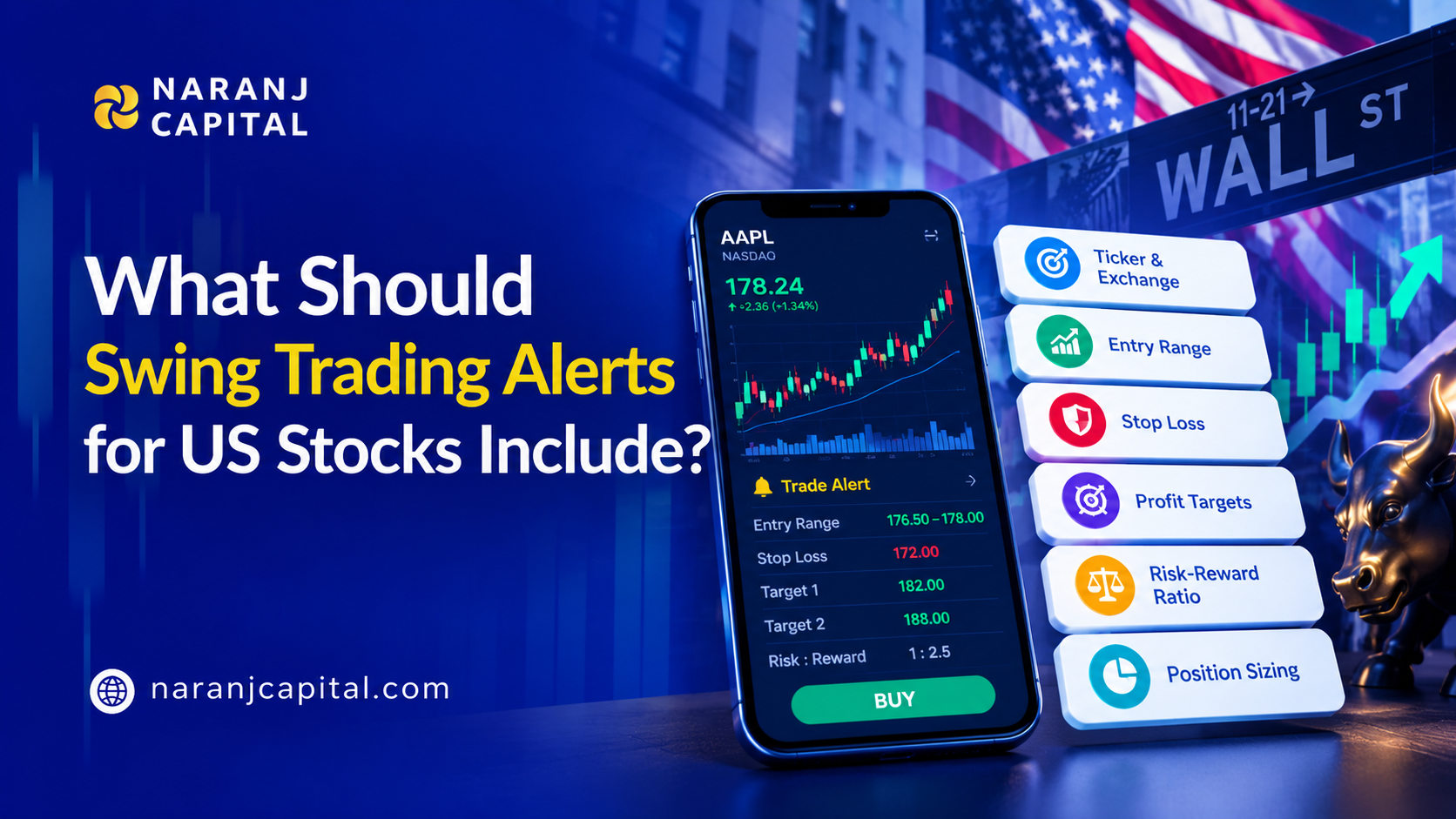
Professional swing trading alerts for US stocks must include an exact ticker, defined buy range, explicit stop-loss, structured profit targets, and clear risk-reward metrics. Relying on an institutional swing trading advisory service for US stocks helps short-term equity traders execute disciplined multi-day strategies across NYSE and NASDAQ listed companies.
Navigating the fast-moving American equity market requires high precision and disciplined execution rules. Active market participants rely heavily on structured swing trading alerts for US stocks to spot short-term momentum shifts across NYSE and NASDAQ equities without monitoring live charts continuously. A professional swing trading advisory service for US stocks delivers systematic trade setups engineered to capitalize on multi-day trend continuation. Understanding the vital components of an actionable trade notification ensures you manage portfolio risk effectively while executing positions with clarity.
Essential Components of Institutional-Grade Trade Alerts
A complete stock trade alert must eliminate guesswork completely. Raw market notifications lacking specific entry bounds or risk controls frequently lead to sub-optimal execution. Below is a structured breakdown comparing basic market notifications against institutional-grade trade signals:
| Component | Basic Price Alert | Professional Swing Trading Signal |
|---|---|---|
| Ticker Symbol | Included (e.g., NVDA, MSFT) | Included with exchange context |
| Entry Parameter | Single spot price | Defined entry range or buy zone |
| Risk Control | None | Explicit stop-loss price level |
| Profit Targets | None | Multiple target price tiers (T1, T2) |
| Risk-Reward Metric | Omitted | Defined ratio (minimum 1:2) |
| Position Sizing | No guidance | Percentage allocation based on risk |
Technical Analysis Foundation in Alert Generation
Real-time swing trading alerts for US stocks leverage a combination of quantitative market indicators to confirm trend strength and price momentum. Professional analysts evaluate structural market dynamics before issuing signal dispatches:
- Moving Average Convergence Divergence (MACD): Tracks momentum shifts and confirms trend direction, signalling high-probability entry windows during bullish baseline crossovers.
- Relative Strength Index (RSI): Identifies overbought or oversold price conditions, helping traders avoid entering extended equity positions near local exhaustion levels.
- Volume Profile and VWAP: Validates institutional liquidity participation and establishes fair value price reference levels for trade execution.
- Support and Resistance Confluence: Pinpoints specific price zones where historical demand or supply creates favorable trade boundaries.
Step-by-Step Alert Evaluation Framework
Evaluating an actionable signal dispatch requires verifying key position parameters promptly. High-quality swing trading alerts for US stocks combine precise trade boundaries with sound portfolio risk management. Active traders review four essential steps before entering a market position:
| Step | Verification Action | Trading Purpose |
|---|---|---|
| 1 | Confirm current market price sits inside defined buy zone | Prevents chasing overextended stock moves |
| 2 | Measure exact percentage distance to active stop-loss level | Defines maximum capital risk per trade |
| 3 | Verify primary profit target offers favorable reward payout | Ensures positive mathematical expectancy |
| 4 | Place limit orders near recommended entry parameters | Guarantees disciplined order fill execution |
Selecting a premium swing trading advisory service for US stocks transforms complex market analysis into organized, actionable insights. Consistent, well-structured trade alerts allow short-term equity investors to execute disciplined strategies while safeguarding capital against sudden market volatility.
Frequently Asked Questions
1. What is swing trading, and how do swing trading alerts for US stocks work in practice?
Swing trading is an active trading strategy that aims to capture price momentum over a holding period ranging from several days to a few weeks. Swing trading alerts for US stocks deliver actionable real-time notifications directly to investors when technical patterns signal a high-probability opportunity on NYSE or NASDAQ equities. Each alert provides pre-calculated parameters, including an entry range, stop-loss price, and profit target, eliminating manual chart analysis.
2. What essential parameters must be present in a professional US stock trading signal?
A complete US stock trading signal must include five core elements:
- Stock Ticker and Exchange: Clear identification of the US equity (e.g., AAPL on NASDAQ).
- Buy Zone / Entry Range: A specific price window rather than a single fixed price.
- Stop-Loss Level: An exact price threshold to limit downside capital risk.
- Take-Profit Targets: Scaled price objectives (T1, T2) to lock in gains.
- Risk-Reward Ratio: A calculated balance establishing at least a 1:2 risk-to-reward outlook.
3. How does a US stock market advisory subscription actually work?
A US stock market advisory subscription grants members access to professionally researched trade recommendations, portfolio updates, and market risk alerts. Subscribers receive instant notifications via email, app, or messaging channels whenever analysts detect a breakout or reversal pattern. The service provides defined execution guidelines, enabling subscribers to place trades with their preferred broker.
4. What technical indicators are most reliable for swing trading alerts on NYSE and NASDAQ stocks?
The most reliable technical indicators for generating swing trading signals include:
- MACD (Moving Average Convergence Divergence): Confirms trend direction and momentum shifts.
- RSI (Relative Strength Index): Spots overbought and oversold price thresholds.
- Exponential Moving Averages (20 EMA & 50 EMA): Identifies dynamic support and resistance zones.
- Volume Profile: Confirms institutional liquidity and trading activity at key price levels.
5. What is the difference between a real-time swing trading alert and a basic stock price alert?
A basic stock price alert merely notifies you when a stock reaches a specific price, offering no contextual strategy. In contrast, a real-time swing trading alert is a fully researched trade setup that combines entry boundaries, protective stop-loss levels, multiple target tiers, and risk management parameters based on comprehensive technical analysis.
6. Why is a buy range better than a single entry price in swing trading alerts?
Stock prices move rapidly in live US equity markets, making exact single-price fills difficult. A defined buy range gives traders a realistic price window within which the trade setup remains mathematically valid and risk-appropriate, preventing costly slippage or FOMO execution.
7. How do stop-loss levels protect traders when following US stock alerts?
Stop-loss levels act as an automated safety net by defining the precise price at which a trade setup is invalidated. If market conditions turn unexpected, the stop-loss exits the position to cap losses at a predetermined percentage, protecting trading capital from severe drawdowns.
8. Can international investors use a US swing trading advisory service legally?
Yes, international investors can legally subscribe to a US swing trading advisory service and trade NYSE and NASDAQ equities. Non-US residents simply need an active account with a international broker supporting US markets along with a completed W-8BEN form for tax compliance.