Introduction
Imagine waking up one morning and finding that everything you saved your whole life has vanished overnight.
Your bank is closed. Your job is gone. Your savings do not exist anymore. The shop on the corner is boarded up. Half your neighbours are in the same situation.
This is not a nightmare. This is what happened to millions of ordinary Americans starting in 1929. And it was called the Great Depression.
It was not just a bad few months. It lasted an entire decade. And it changed the way governments, banks, and economies operate to this day.
The 1920s: When Everything Felt Perfect
To understand why the crash hit so hard, you need to understand how good things felt just before it.
The 1920s in America was called the Roaring Twenties for a reason. Factories were booming. Cars were being made by the millions. Radios were in every living room. Jazz music filled the air. People felt rich and unstoppable.
And the stock market was flying.
Whether someone invests independently or follows trading advisory services for USA stocks, understanding the biggest market crashes in history is just as important as identifying investment opportunities. The Great Depression remains one of the most important lessons in why risk management, diversification, and disciplined investing matter.
Ordinary Americans, not just the wealthy, were buying shares in companies. Banks were lending money freely to anyone who wanted to invest. People were buying shares on something called margin. This meant you could buy $100 worth of shares with just $10 of your own money, borrowing the rest from your broker.
It felt like easy money. Everyone was doing it. Share prices kept rising and nobody imagined they could fall.
But they were building on borrowed money and borrowed time.
Black Thursday: The Day It All Fell Apart
On October 24, 1929, a Thursday morning, investors began selling their shares.
Then more people sold. Then panic spread. Within hours, everyone was trying to sell and almost nobody was buying. Share prices collapsed in real time on the floor of the New York Stock Exchange.
That day became known as Black Thursday. It was followed by Black Monday and Black Tuesday. By the end of that week, the American stock market had lost billions of dollars in value.
People who had borrowed money to buy shares suddenly owed more than their shares were worth. Brokers demanded their money back immediately. Investors were wiped out.
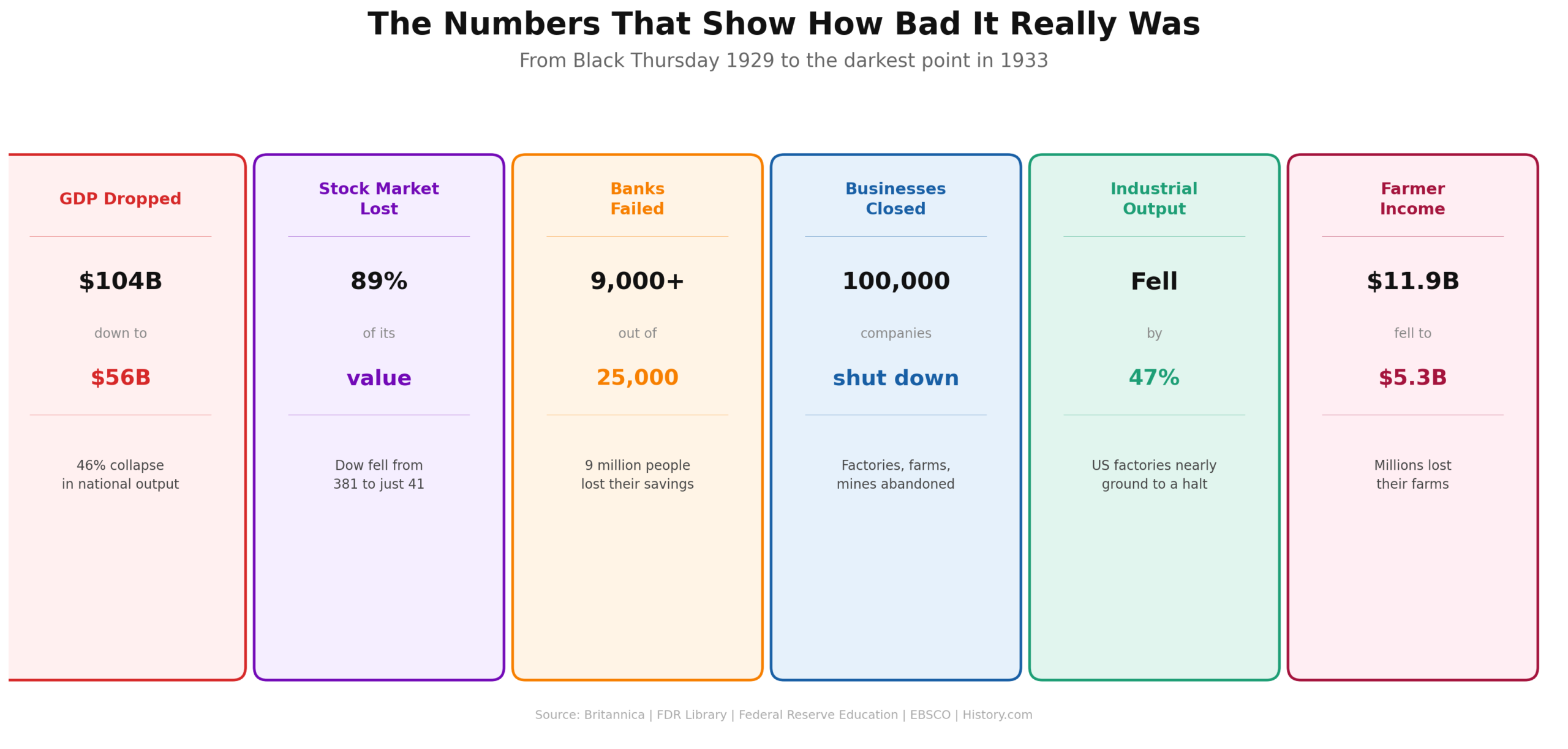
The Dow Jones index, which tracks the biggest American companies, had been at 381 points before the crash. By 1932 it had fallen all the way to 41. That is a collapse of nearly 90 percent.
Seventy-four billion dollars of wealth disappeared from the American economy in a matter of weeks.
The Domino Effect That Nobody Could Stop
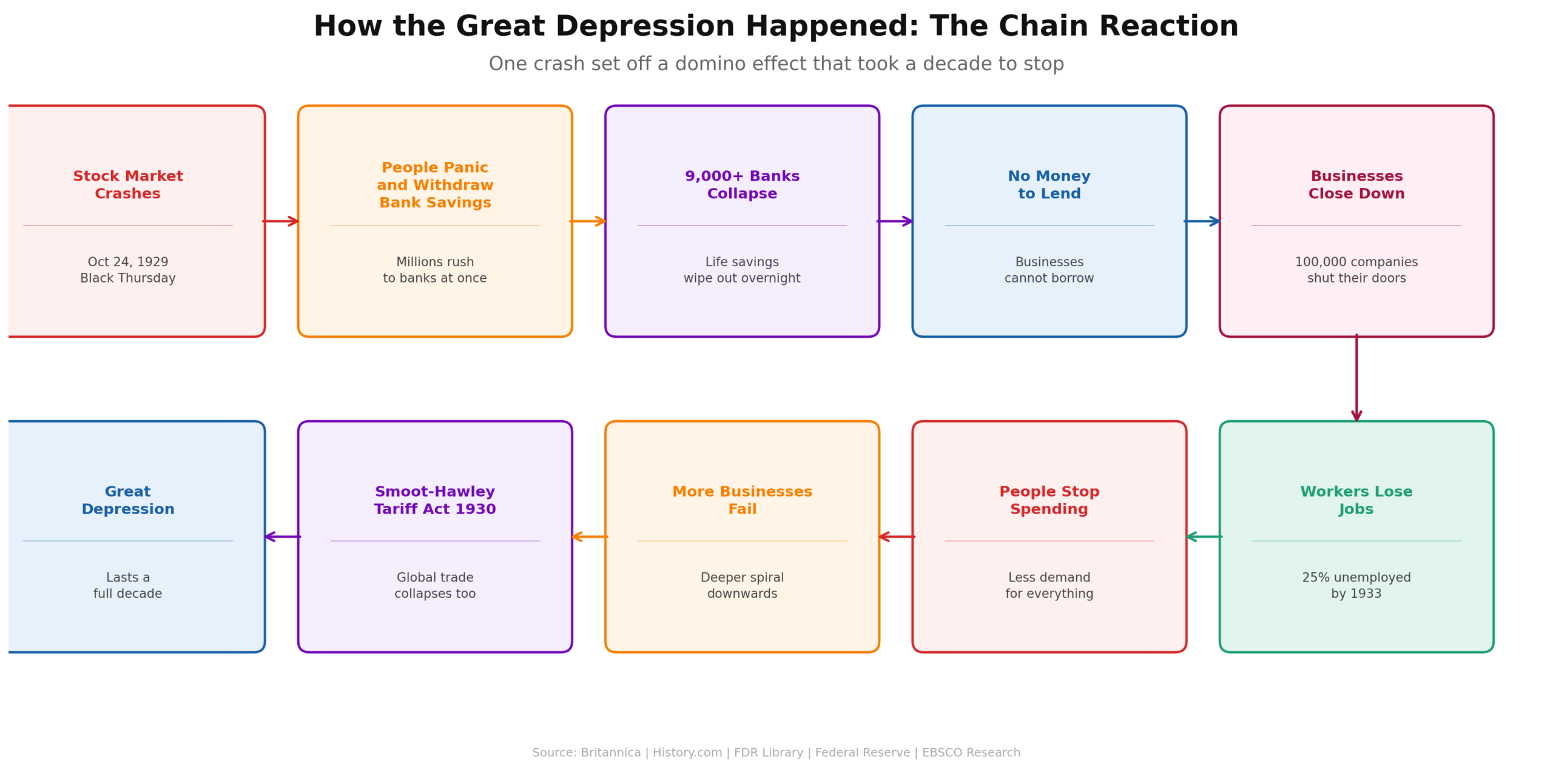
The stock market crash was just the beginning. What followed was a chain reaction that spread through every corner of American life.
People were frightened. They rushed to their banks to pull out their savings in cash. But banks had lent out most of that money. When thousands of people arrived at the same time demanding their deposits back, the banks had nothing to give.
Banks began failing one after another. Between 1929 and 1933, more than 9,000 banks across America collapsed. Nine million families lost their entire savings overnight. The money was simply gone with no government protection at the time.
With banks gone, businesses could not borrow money to pay workers or buy supplies. So they started closing down. Over 100,000 businesses shut their doors. Factories went silent. Mines were abandoned. Farms went into foreclosure because owners could not keep up with loan payments.
The government made things worse without realising it. In 1930, Congress passed the Smoot-Hawley Tariff Act, which put heavy taxes on imported goods from other countries. The intention was to protect American businesses. But other countries responded by putting the same high taxes on American goods. International trade collapsed. Exports from America fell sharply. The crisis spread from America to Europe and the rest of the world.
What Life Actually Looked Like
Numbers can only tell you so much. The real story is in what ordinary Americans experienced day to day.
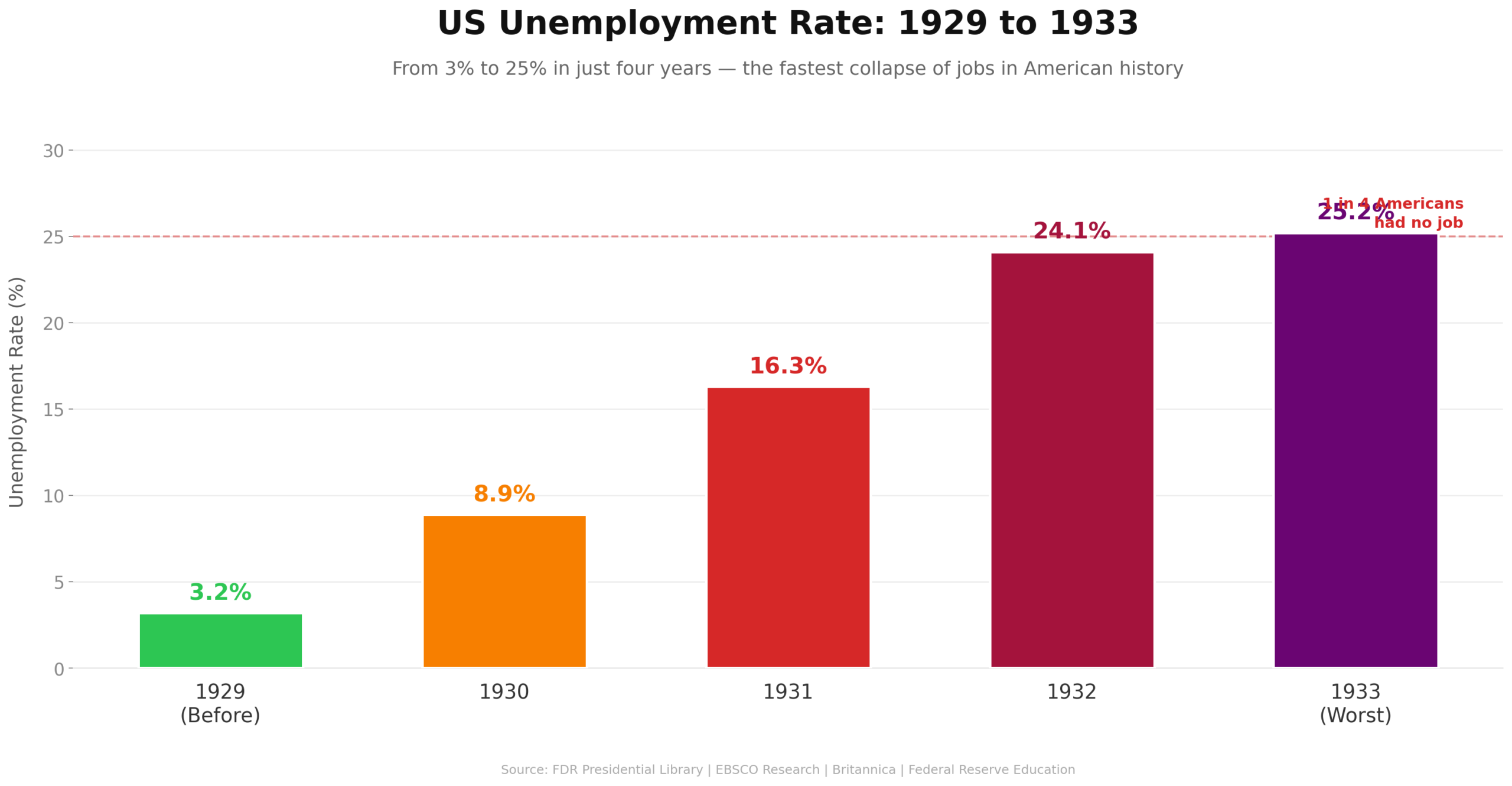
By 1933, one in four American workers had no job. In some cities like Toledo, Ohio, unemployment reached 80 percent. The national figure stayed above 14 percent every single year throughout the 1930s.
Wages for those lucky enough to keep their jobs fell by over 40 percent.
Food became desperately scarce for millions. Bread lines stretched around city blocks. Soup kitchens run by charities fed tens of thousands of people daily. A chicken that had cost 38 cents a pound now cost only 12 cents because farmers were so desperate. Eggs fell from 50 cents a dozen to 13 cents. Yet many families still could not afford them.
Farmers faced a double disaster. Along with the economic collapse, a massive drought hit the Great Plains states throughout the 1930s. Crops failed. Soil turned to dust. Strong winds blew it into massive dust storms that buried farms and homes. This region became known as the Dust Bowl. Hundreds of thousands of farm families packed their belongings and migrated westward searching for any work they could find.
Over one million Americans lost their homes. Shantytowns made of cardboard and scrap wood appeared on the edges of cities. People called them Hoovervilles, named mockingly after President Herbert Hoover who many blamed for not doing enough to help.
Children suffered too. Around 333,000 could not attend school. Many schools were open only three days a week because there was no money to run them.
The Response That Changed Everything
President Herbert Hoover believed the economy would fix itself. He resisted large government spending and instead encouraged businesses to voluntarily cooperate to stabilise things. It did not work. The situation kept getting worse.
In 1932, Americans voted overwhelmingly for a new president. Franklin D. Roosevelt, known as FDR, came to office promising a New Deal for ordinary Americans.
Within his first hundred days in office, FDR signed a wave of new laws and programmes. He declared a bank holiday to stop the panic and reorganised the banking system. He created the Federal Deposit Insurance Corporation, which guaranteed people's savings so they would never again lose their money in a bank failure.
New programmes put millions of unemployed Americans back to work building roads, bridges, schools, and parks. The Social Security Act of 1935 created a safety net for the elderly and unemployed for the first time in American history. Government regulation of banks and the stock market was strengthened to prevent reckless speculation from happening again.
The recovery was slow and uneven. As late as 1938, unemployment still stood above 12 percent. It was ultimately the massive government spending required for World War Two that finally ended the Depression completely and put all Americans back to work.
What We Learned That Still Matters Today
The Great Depression did not just cause suffering. It changed how the world thinks about money, government, and economic safety.
Before 1929, most people believed the market always fixed itself and governments should stay out of the way. After the Depression, that view changed permanently. Governments everywhere accepted a responsibility to protect their citizens from economic collapse.
Bank deposits are now insured. Central banks actively manage the economy. Social safety nets exist to support the unemployed. Every one of these systems was created or strengthened because of lessons learned during those ten painful years.
When the 2008 financial crisis hit, economists and governments looked back at the Great Depression and used its lessons to avoid a repeat. They moved fast. They insured banks. They injected money into the economy. It still hurt badly. But it did not last a decade.
While investors today have access to far better regulations, technology, and market data than those in 1929, market corrections remain an unavoidable part of investing. Whether you focus on long-term wealth creation or regularly follow short term trading tips on US stocks, understanding past crashes can help you make more informed decisions and avoid emotional mistakes during periods of extreme volatility.
The Great Depression of 1929 was not just history. It is the instruction manual that modern economies still follow when things go wrong.