Introduction
A coworker mentions a stock over lunch. That evening, it's all over your group chat. By the weekend it's trending online, and it's up 40% in two weeks.
You don't know much about the company. But everyone seems to be buying it, so you buy too.
Three weeks later, you're down 25%, and the crowd has quietly moved on to the next big thing.
If that sounds familiar, you've met the bandwagon effect. Here's how it works, what it does to your stock picking, and how to protect yourself.
This behaviour is particularly common in the US stock market, where trending stocks can attract enormous attention from retail investors. However, identifying opportunities requires more than following popular names. Evaluating US stock market recommendations through independent research, company fundamentals, price trends, and risk levels can help investors avoid buying simply because everyone else is doing so.
What Is the Bandwagon Effect?
The bandwagon effect is the tendency to adopt a belief or behavior simply because lots of other people have. The name comes from parade wagons carrying a band. As the music got louder, more and more people jumped on.
In investing, the music is a rising price, a flood of headlines, and a buzz of confident voices. And jumping on feels like the smart thing to do.
Why It's So Powerful With Stocks
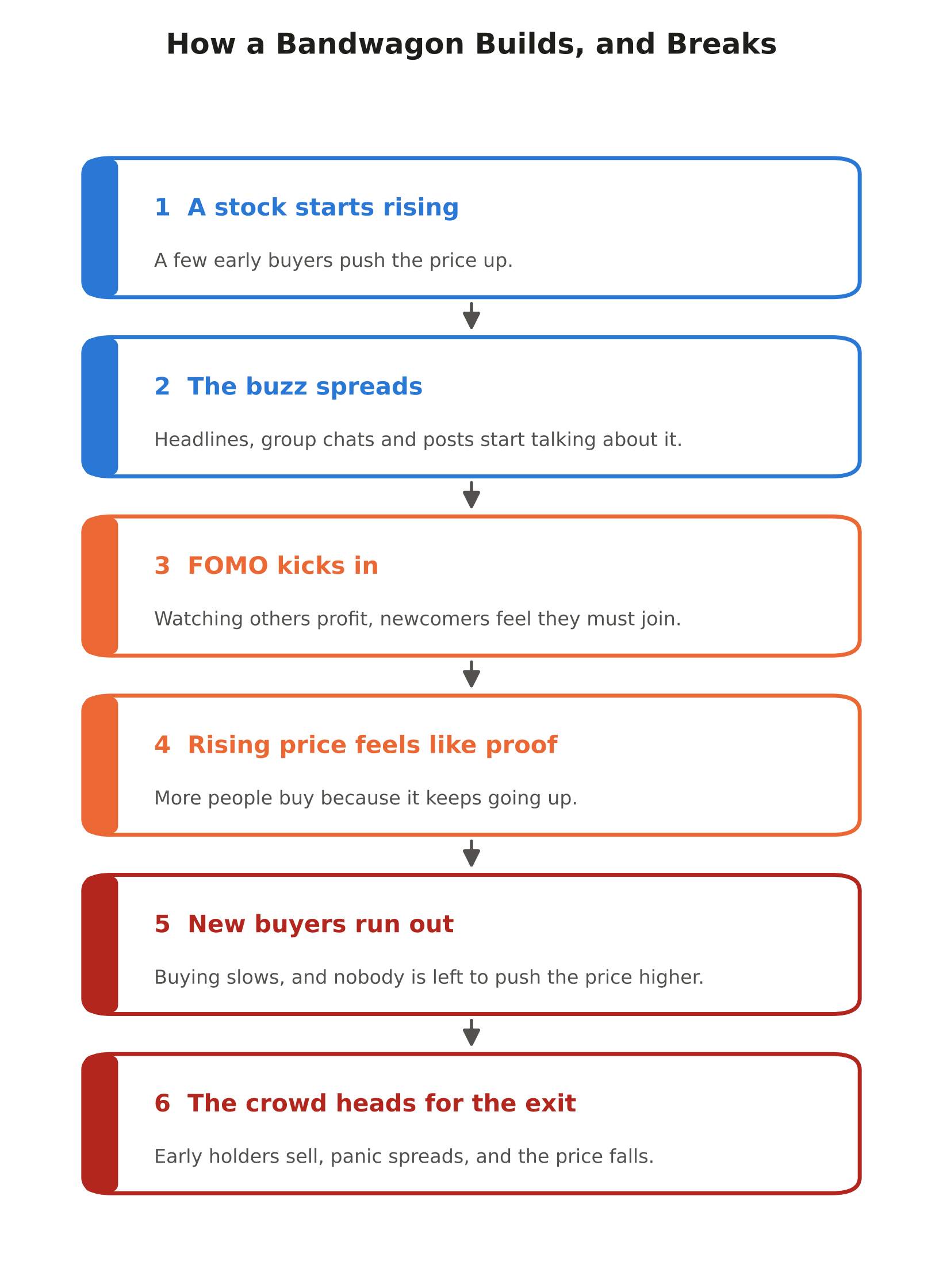
- Rising prices feel like proof. If a stock keeps climbing, it's easy to assume everyone else knows something you don't.
- Fear of missing out. Watching others profit hurts more than it should.
- Uncertainty. Picking stocks is hard. Copying the crowd feels like a shortcut to confidence.
- Safety in numbers. Being wrong alone feels worse than being wrong with everyone else.
- Always-on feeds. Group chats, social media, and news alerts put "everyone's buying it" in your pocket all day.
How It Shows Up in Your Picks
- You buy a stock after it has already soared, because that's when you first notice it.
- You buy because of mentions, not research: a headline, a viral post, a friend's tip.
- You copy a famous investor's holdings without knowing why they own them, or at what price.
- You sell in a panic because everyone else is selling. That's the bandwagon in reverse.
What the Research Says
Finance professors Brad Barber and Terrance Odean studied how individual investors buy. Their work, published in the Review of Financial Studies, found that individual investors tend to be net buyers of attention-grabbing stocks. That means stocks in the news, stocks with unusually heavy trading volume, and stocks that just had an extreme one-day move.
They also found that stocks individuals bought on those high-attention days tended to underperform the stocks those same investors sold.
Why does this happen? With thousands of stocks to choose from, many people only consider the ones that have already caught their attention. And the stocks that catch your eye are usually the ones everyone else is watching too.
Case One: The Dot-Com Bubble
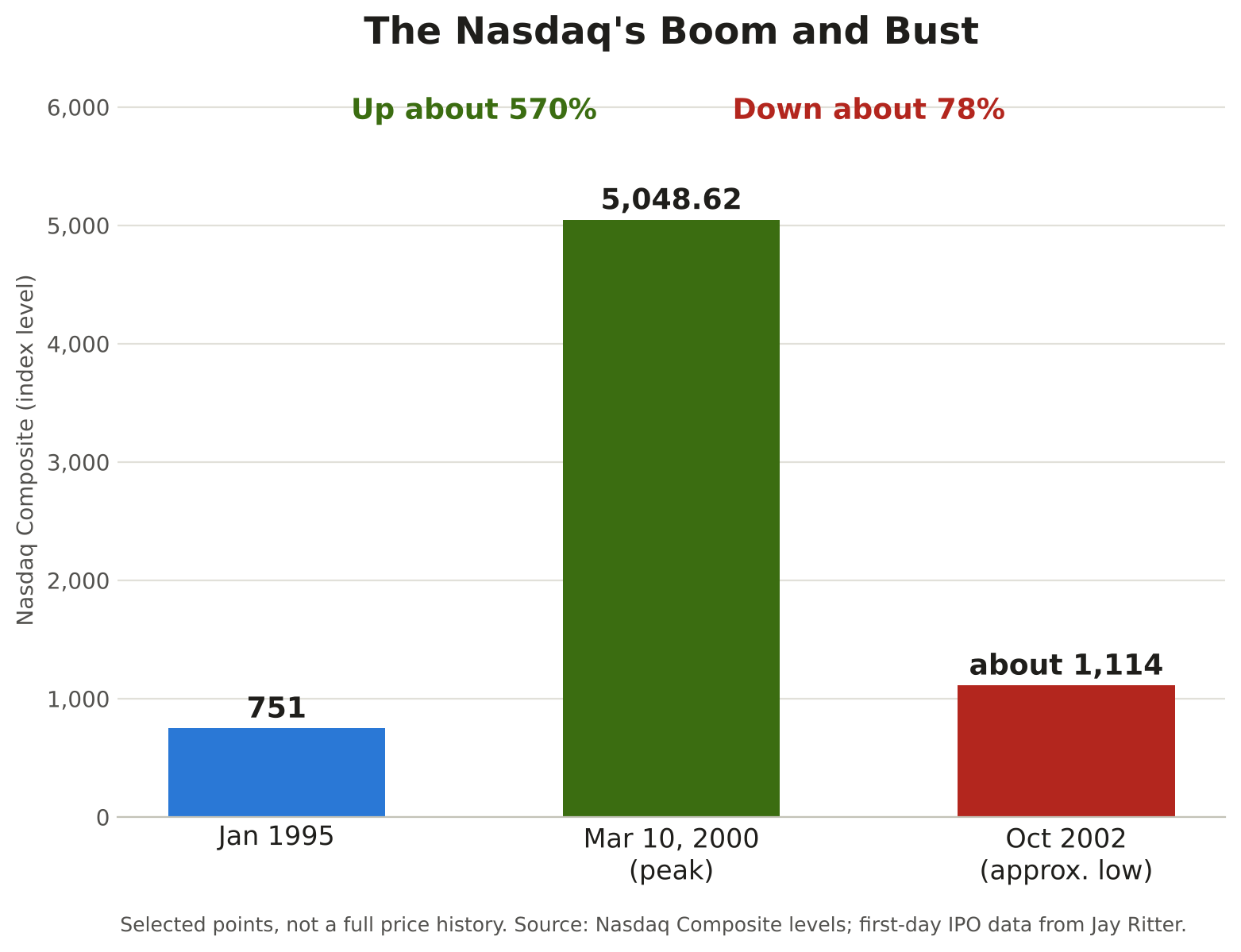
Between January 1995 and March 10, 2000, the Nasdaq Composite surged about 570%, from 751 to a peak of 5,048.62. In 1999, the average IPO gained about 71% on its first day, according to IPO data compiled by Professor Jay Ritter of the University of Florida.
Investors piled into internet companies partly because everyone else was.
Then the music stopped. By October 2002, the Nasdaq had fallen about 78% from its peak.
Case Two: GameStop
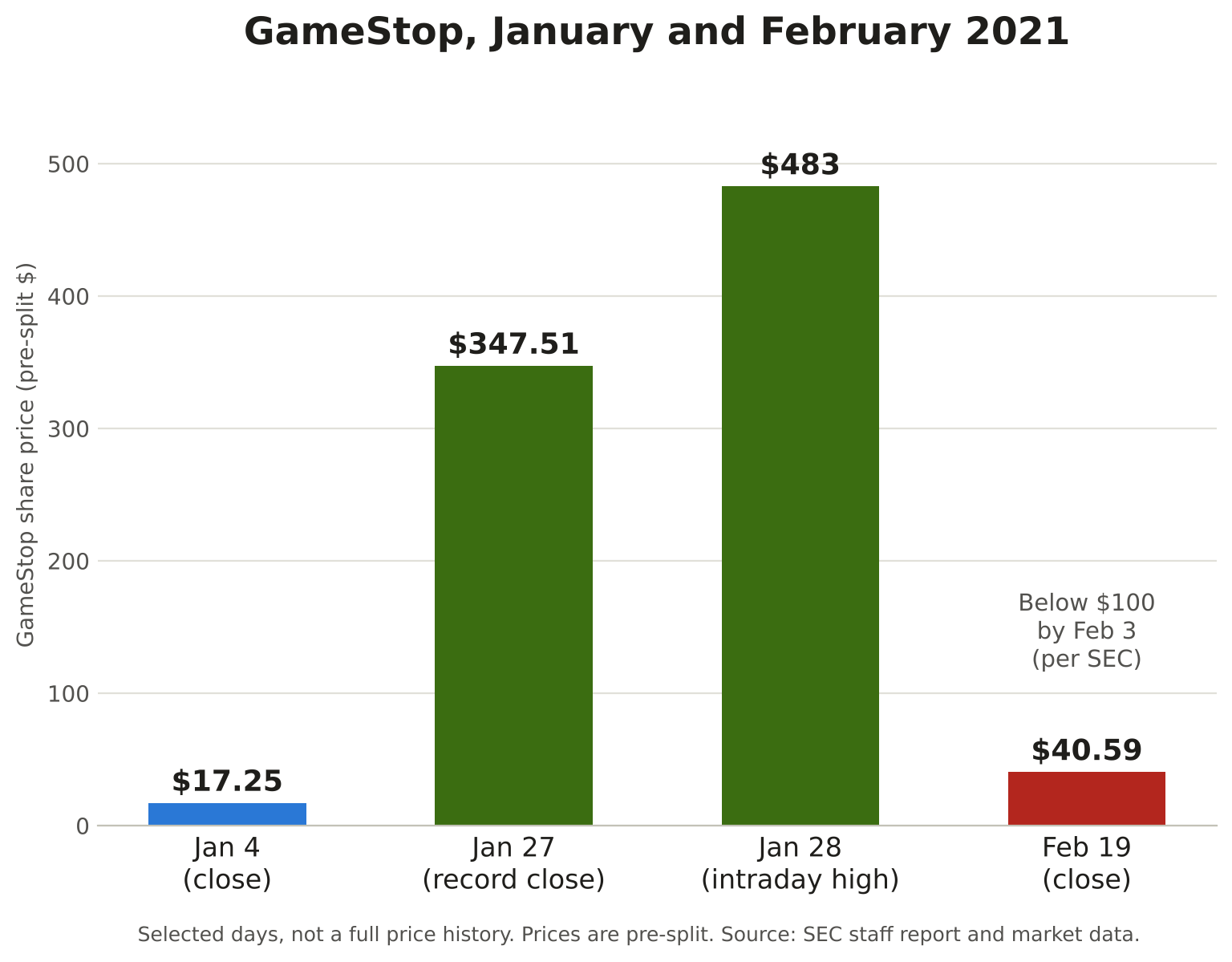
In January 2021, GameStop's shares rose from a $17.25 close on January 4 to an intraday high of $483 on January 28 (pre-split prices). A short squeeze played a big part, because the stock was so heavily bet against. But so did a wave of crowd buying fueled by social media and intense media attention.
Then it fell. According to the SEC, the stock was below $100 by February 3. By February 19, it closed at $40.59, more than 90% below that peak.
Anyone who bought near the top had the furthest to fall.
The Problem: The Crowd Needs Newcomers
A bandwagon only keeps rolling while new riders keep climbing aboard. When the buying slows, nobody is left to push the price higher.
That's why timing matters. By the time a stock feels unmissable, much of the easy gain may be behind it, and you could be among the last buyers instead of the first. Early holders who sell into the rush are often the ones who benefit from your purchase.
Is Following the Crowd Ever OK?
Fairness matters here. Crowds aren't always wrong. Trends can last longer than skeptics expect, and a popular stock may well be a great company.
The problem isn't noticing what's popular. It's letting popularity be your reason. Treat a buzzing stock as a starting point for research, not the conclusion.
Your Five-Question Bandwagon Check
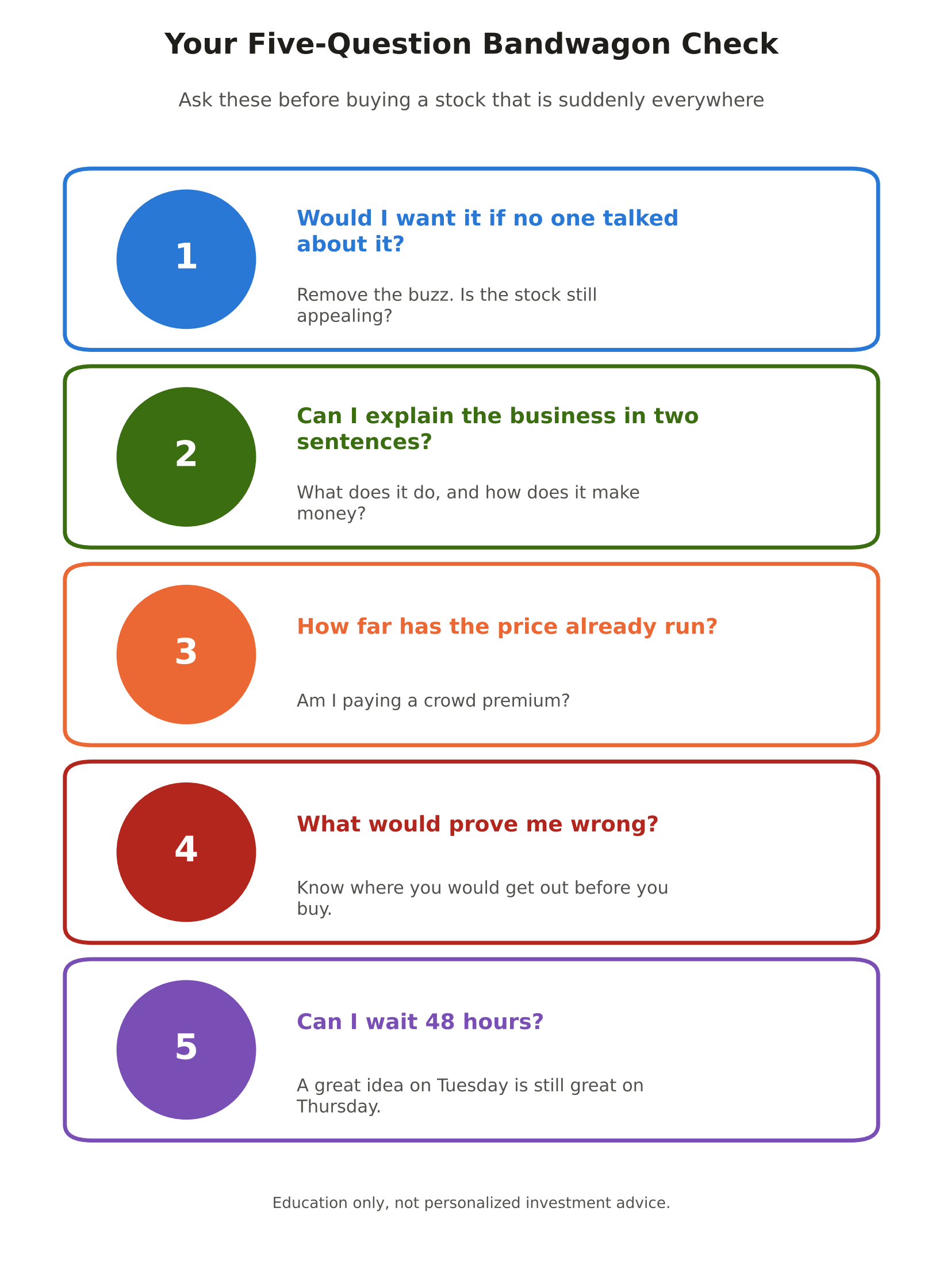
Before you buy a stock that has suddenly appeared everywhere, ask yourself:
- Would I want this stock if no one else were talking about it?
- Can I explain, in two sentences, what the company does and how it makes money?
- How far has the price already run? Am I paying a crowd premium?
- What would prove me wrong, and where would I get out?
- Can I wait 48 hours? A great idea on Tuesday is usually still a great idea on Thursday.
A Few Habits That Help
- Do your own research first, then see what the crowd thinks, not the other way around.
- Keep position sizes small on "hot" ideas.
- Limit your exposure to noisy feeds during fast-moving markets.
- Automate part of your investing, such as regular contributions to diversified funds, so fewer decisions get made in the heat of the moment.
- Keep a short journal of why you bought each stock. If the reason is "everyone was talking about it," that's your warning sign.
Successful stock trading requires patience, independent analysis, and a clear understanding of risk. Investors seeking research-backed USA stock trading advice should prioritise well-structured opportunities with defined entry levels, realistic targets, and appropriate risk management rather than chasing stocks driven by market excitement.
Conclusion
A crowd is a poor substitute for a reason.
The bandwagon is loud, exciting, and full of confident people. But when the music stops, no one asks how many were on board. They ask who is still holding the stock.
If you ever do jump on, make sure it's because you checked where the wagon is going, not just how many people are riding it.