Introduction
Most people look at a stock and ask, "How much can I make?" It's a natural question, but it's the wrong one to ask first.
The better question is, "How much do I lose if I'm wrong?" A positional trade, one you hold for weeks or months, ties up your money and your attention. So before you click buy, it pays to run the same simple checks every time. Let's walk through them, step by step, with a worked example.
For investors participating in the US stock market, evaluating risk before entering a trade is an important part of disciplined investing. Professional trading advisory services for USA stocks can help traders assess market trends, identify potential setups, and understand the risk and reward involved before committing capital.
What Is Risk-to-Reward?
Risk-to-reward compares what you stand to lose with what you hope to gain.
Think of entering a contest. You look at the entry fee and the prize before you sign up. If the fee is $1 and the prize is $3, that's a decent bet. If the fee is $3 and the prize is $1, you'd walk away. A trade works the same way. Your possible loss is the entry fee. Your possible gain is the prize.
Step 1: Start With the Thesis
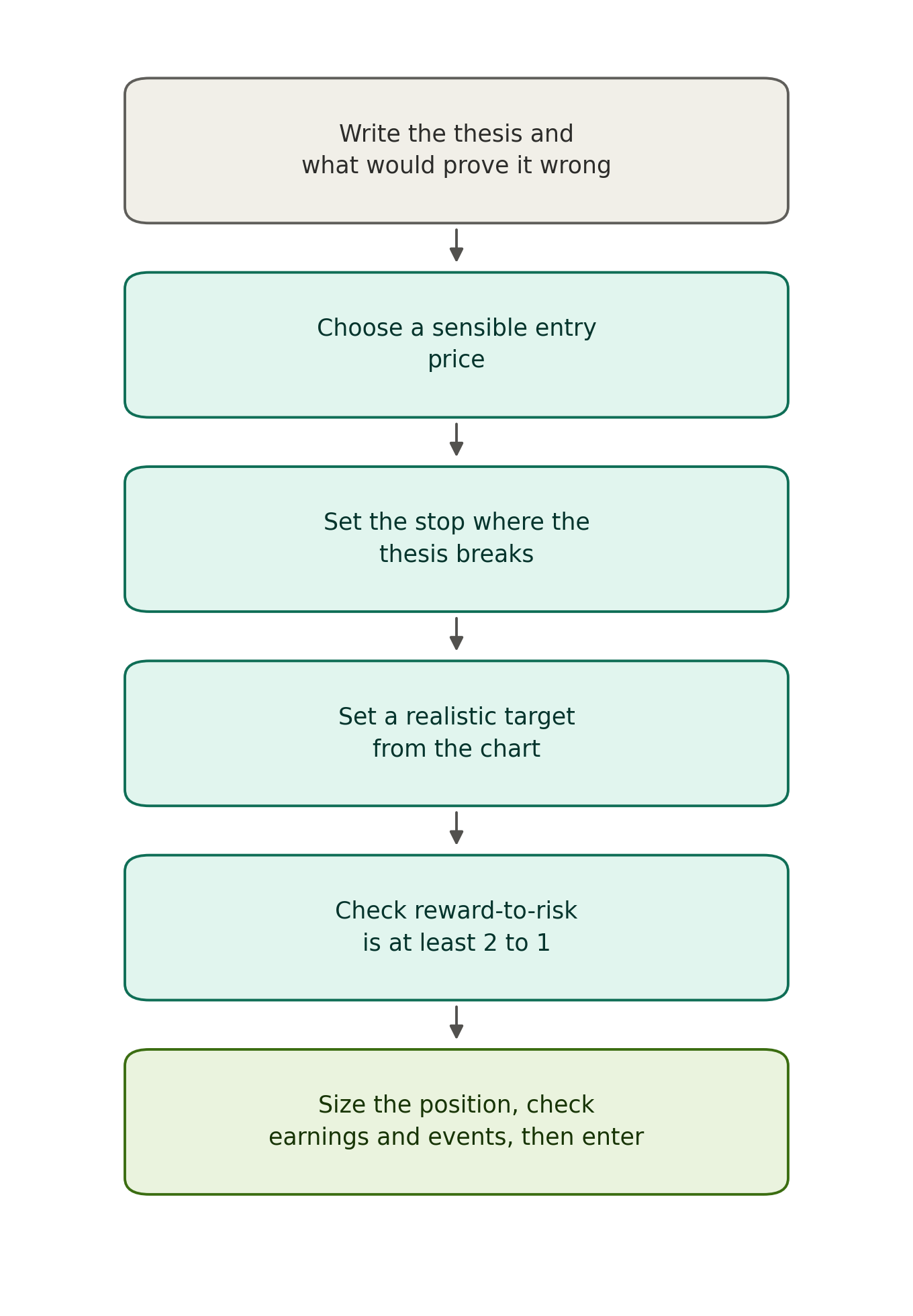
Why do you think this stock will move, and over what time frame? Maybe earnings are growing, the stock just broke out of a long base, or its whole sector is gaining strength.
Write it in one sentence. Then answer a second question: what would prove me wrong? That answer becomes the foundation of your stop.
Step 2: Choose a Sensible Entry
Where you buy sets both sides of the ratio. Buy after a big run-up, and your reward shrinks while your risk stretches. Wait for a pullback to support, or for a breakout to retest its level, and both can improve.
A great stock at the wrong price can still be a poor trade.
Step 3: Place the Stop Where the Thesis Breaks
A stop-loss isn't the amount of pain you can tolerate. It's the price that tells you your idea was wrong.
Traders often anchor it below a recent swing low or a major support level, below a key moving average, or at a multiple of the stock's average daily range. Positional trades need more breathing room than day trades, because normal swings are bigger over weeks. And once you're in, never move a stop further away to avoid taking a loss.
Step 4: Set a Realistic Target
Targets should come from the chart or the analysis, not from hope. Common anchors include the next resistance level, a prior high, a measured move up from the base, or a valuation level you can defend.
Then ask honestly: can this stock reasonably get there in my time frame?
Step 5: Do the Math
The formula is simple. Reward-to-risk equals the distance to your target divided by the distance to your stop.
Say a fictional stock trades at $100. Support sits at $92, so that's your stop. Your target is $124.
| Item | Amount |
|---|---|
| Entry | $100 |
| Stop | $92 |
| Target | $124 |
| Risk per share | $8 |
| Reward per share | $24 |
| Reward-to-risk | 3 to 1 |
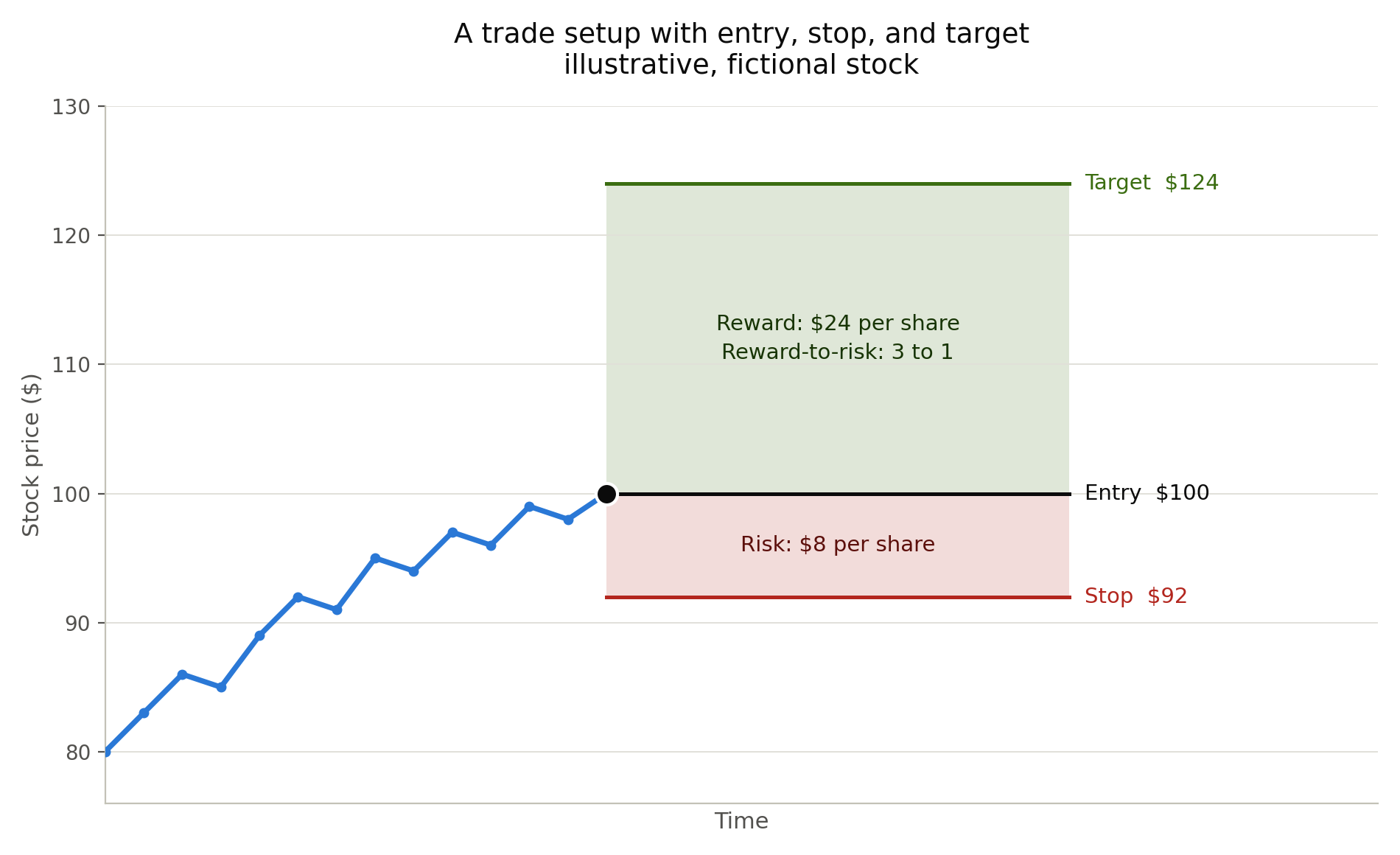
Many traders look for at least 2 to 1 before entering. That's a rule of thumb, not a law. If the math falls short, skip the trade or wait for a better entry.
What you shouldn't do is force the ratio to work. Squeezing the stop too tight gets you knocked out by ordinary noise. Stretching the target to an unrealistic level just hides a bad setup.
Why the Ratio Matters: The Win Rate Math
Here's the good news. You don't have to be right most of the time if your winners are bigger than your losers.
The win rate you need just to break even is 1 divided by (1 plus your reward-to-risk). At 1 to 1, you need to win half the time. At 3 to 1, you only need to win one trade in four. That's before commissions and slippage.
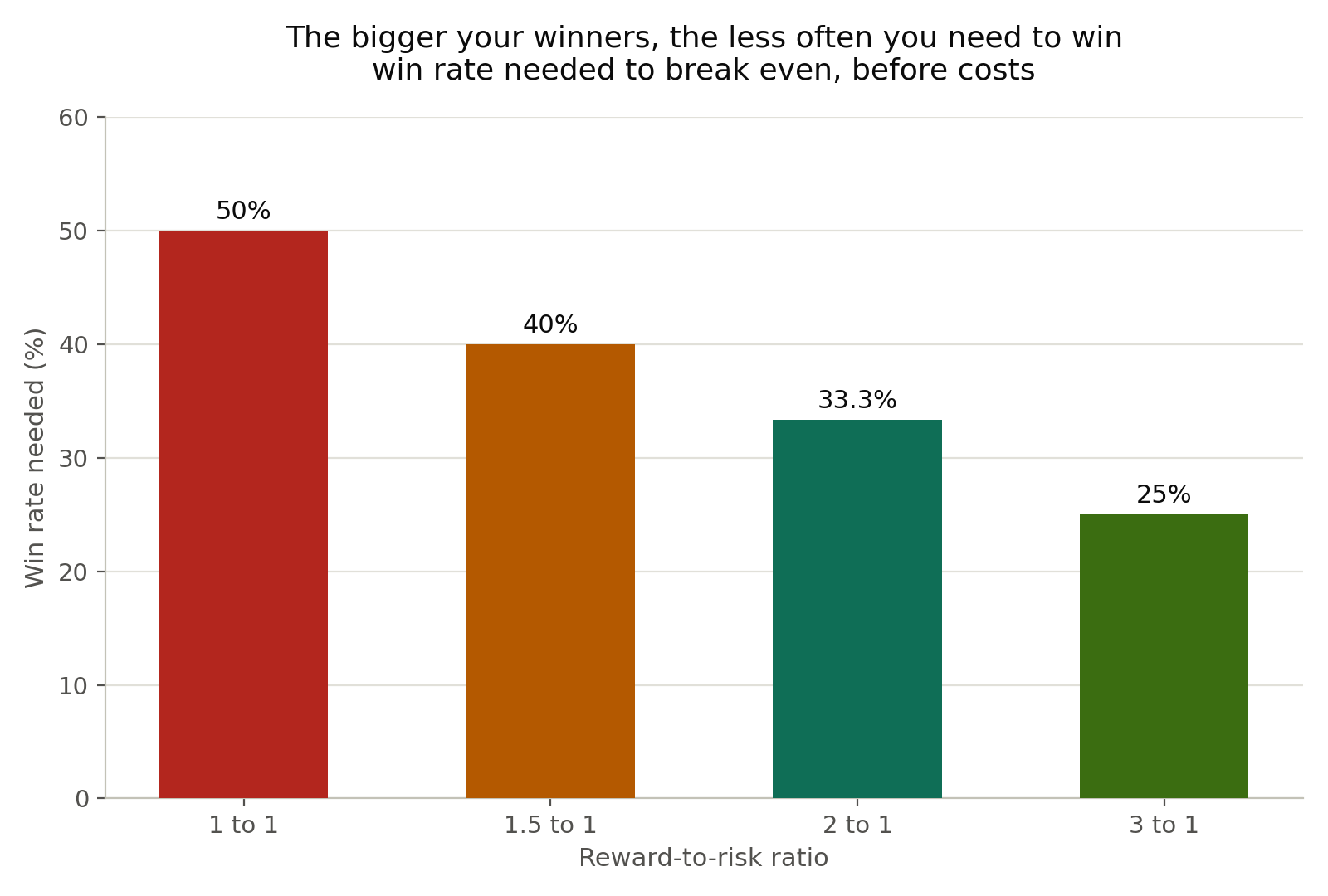
But the ratio alone isn't enough. A 5 to 1 setup that almost never works isn't a good trade. So combine the ratio with an honest guess at your odds, using expected value: win rate times reward, minus loss rate times risk.
For example, with a 40% win rate on a 3 to 1 setup, the math is 0.4 times 3, minus 0.6 times 1, which equals +0.6. On average, that's 60 cents gained for every dollar risked. At a 25% win rate, it drops to zero. Your odds matter as much as your ratio.
Step 6: Size the Position
Now decide how many shares to buy. The formula is your account size times the percent you're willing to risk, divided by the risk per share.
With a $50,000 account and a 1% risk limit, you're risking $500. Divide that by the $8 risk per share, and you get 62 shares, rounding down.
If the stop is hit, you lose about $496. If the target is reached, you gain about $1,488. Many traders risk between 1% and 2% of their account on a single trade. It's a common guideline, not a rule that fits everyone. Also remember to add up the risk across all your open trades, in case several go wrong together.
Step 7: Check for US Market Surprises
Before you enter, scan for things that can break your plan.
- Earnings dates. Positional trades often hold through earnings reports, and a stock can gap far past your stop overnight. A stop order isn't a guaranteed price. In a gap, you're filled at the next available price, which can be much worse.
- Big scheduled events. Federal Reserve meetings and major jobs or inflation reports can move the whole market.
- Liquidity. Check average daily volume so you can actually exit when you need to.
- Overlap. Five stocks that move together are really one big trade.
- Costs. Slippage, commissions, and margin interest if you borrow all eat into the reward.
Your Pre-Trade Checklist
- Can I state my thesis in one sentence?
- Do I know the price that proves me wrong?
- Is my target realistic for my time frame?
- Is reward-to-risk at least 2 to 1?
- Is my position sized so a loss is small?
- Have I checked earnings dates and big events?
Applying these principles consistently takes time, research, and regular market monitoring. Investors looking for positional trading picks in USA stocks should focus on opportunities with a clear technical structure, realistic price targets, and a well-defined risk-management plan rather than chasing stocks simply because they are moving.
Conclusion
A good trade isn't one that wins. It's one where the math was in your favor before you clicked buy.
You'll still be wrong often, and that's fine. The goal isn't to be right every time. It's to take trades where being wrong is cheap and being right pays well.