
Introduction
In just five years, an index went from under 800 to over 5,000. Then, in the next two and a half years, it lost nearly 80% of that. This isn't a hypothetical. It actually happened, and it's called the dot-com bubble.
This isn't just a story about the past. For investors looking for US trading and investment advice, the dot-com bubble remains one of the clearest examples of what can happen when hype moves faster than business fundamentals. It also offers important lessons for anyone following USA stocks today.
What Was the Dot-Com Bubble, Really?
The dot-com bubble was a period in the late 1990s when investors poured money into internet companies, often with little regard for whether those companies actually made money. Stock prices soared on potential and hype rather than profits. Then, starting in March 2000, the bubble burst, and trillions of dollars in value disappeared within a couple of years.
Think of blowing up a balloon at a birthday party. Each breath makes it bigger and more impressive. But keep blowing without stopping, and eventually the size of the balloon isn't proof of anything except that nobody has stopped blowing yet. Eventually, it pops.
How the Bubble Inflated
The internet was genuinely new and exciting, and investors believed it would change everything. They were right about that part. What they got wrong was the timeline, and which companies would actually survive to see it happen.
A few things fed the frenzy:
- Cheap money and easy IPOs. Venture capital flooded into startups, and companies could go public with barely any revenue to show for it.
- "Get big fast" over profits. Businesses burned through cash on marketing and growth, sometimes spending more on a single Super Bowl ad than they made in a year, instead of building something sustainable.
- A ".com" was often enough. Simply adding those four letters to a company name could send its stock soaring, regardless of what the business actually did.
- "Eyeballs over earnings." Traditional measures like profit margins were treated as old-fashioned. Website traffic and future potential were treated as good enough on their own.
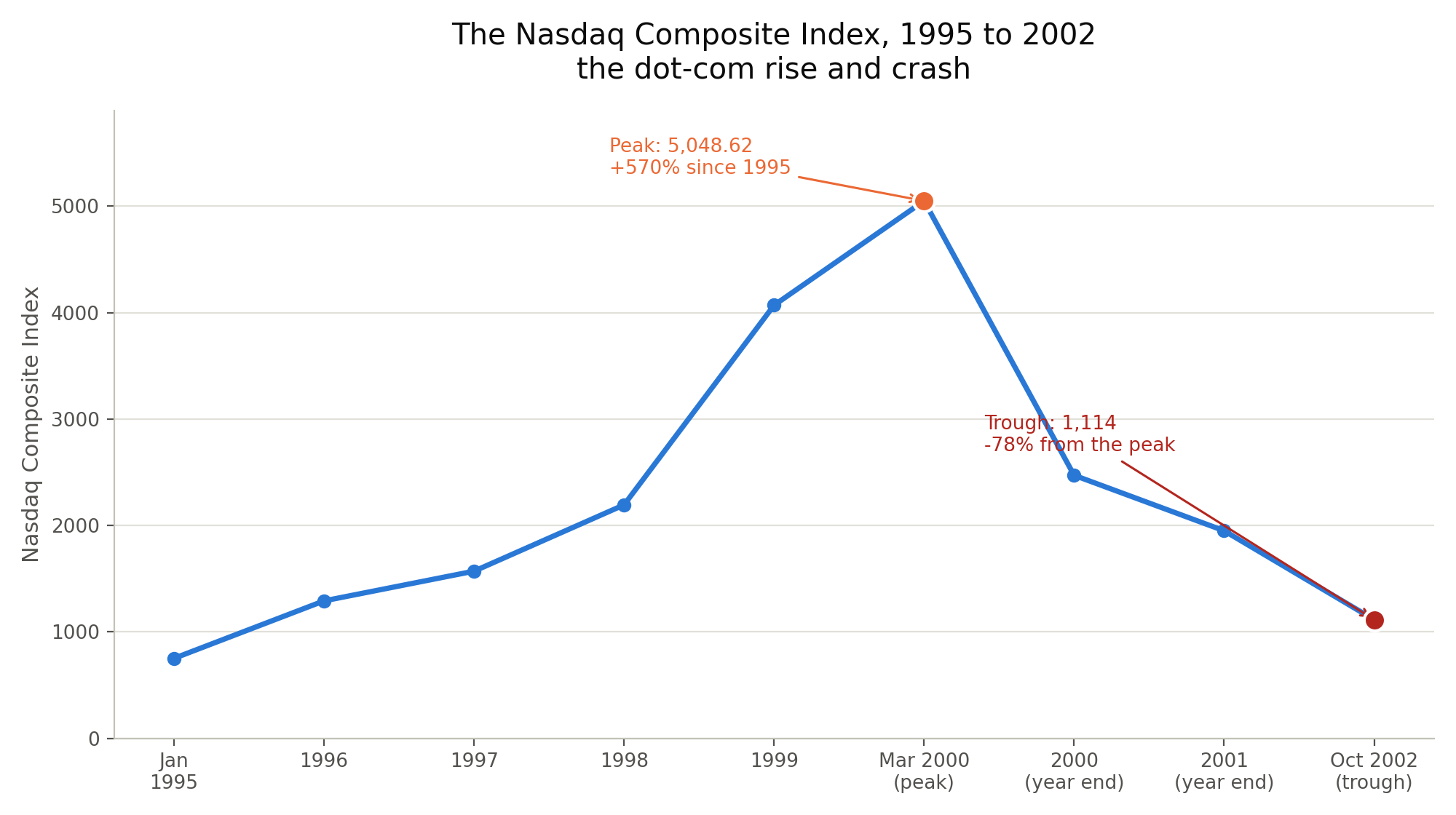
Between January 1995 and March 10, 2000, the Nasdaq Composite surged about 570%, climbing from 751 to a peak of 5,048.62. In 1999 alone, it gained roughly 86%.
The Companies That Defined the Era
[INFOGRAPHIC: Dot-Com Failures vs Dot-Com Survivors]
Some names became cautionary tales. Pet Supplies, Accessories, and Pet Food - Pet Stores | PetSmart , famous for its sock puppet mascot, folded within two years of its IPO. Webvan, an online grocery delivery company, burned through hundreds of millions of dollars before shutting down. Toysrus.com, The Official Toys”R”Us Site - Toys, Games, & More and Boo.com followed similar paths, spending heavily to chase growth that never became profit.
Other companies made it through. Amazon's stock fell from around $100 to about $7 during the crash, a brutal drop, before rebounding to become one of the most valuable companies in the world. eBay also survived and thrived. Cisco, which supplied much of the hardware powering the internet boom, saw its stock fall roughly 86% but lived to remain a major company.
Why It Burst
A few things came together at once. The Federal Reserve raised interest rates to cool inflation, making borrowing more expensive and cash-burning startups far less appealing. A headline about Japan entering a recession triggered a broad global sell-off in March 2000. A court ruling against Microsoft added to the gloom. And as lockup periods on insider shares expired, company insiders began cashing out, adding even more selling pressure.
Once confidence cracked, companies that had never turned a profit had nothing solid to stand on. By October 2002, the Nasdaq had fallen 78% from its peak, wiping out trillions of dollars in value. More than half of all public dot-com companies had failed by 2004. It took until April 2015, fifteen years later, for the Nasdaq to reclaim its old high.
Lessons for Today's Investors
- Revenue and profit still matter, no matter how exciting the story around a company sounds.
- Watch out for growth at any cost. Companies that spend heavily without a real path to profitability can look impressive right up until they run out of cash.
- A rising stock price isn't proof of a strong business. Sometimes it's just proof that a lot of other people are excited too.
- Diversify. Even investors who avoided the worst dot-com failures often still held onto a handful of survivors that kept their portfolios afloat.
- Bubbles rarely announce themselves. They usually just look like "this time it's different," right up until it isn't.
Conclusion
The dot-com bubble didn't destroy the internet. It just separated the companies with real businesses underneath the hype from the ones that were mostly just air.
For investors seeking USA stocks advisory or following the U.S. market, the biggest lesson isn't to avoid the next big technology trend. It's to understand what you're actually paying for.
That balloon at the birthday party always looks its most impressive right before it pops. The trick isn't figuring out exactly when that happens. It's making sure your money isn't riding on the balloon alone.