Introduction
Turn on the news right now.
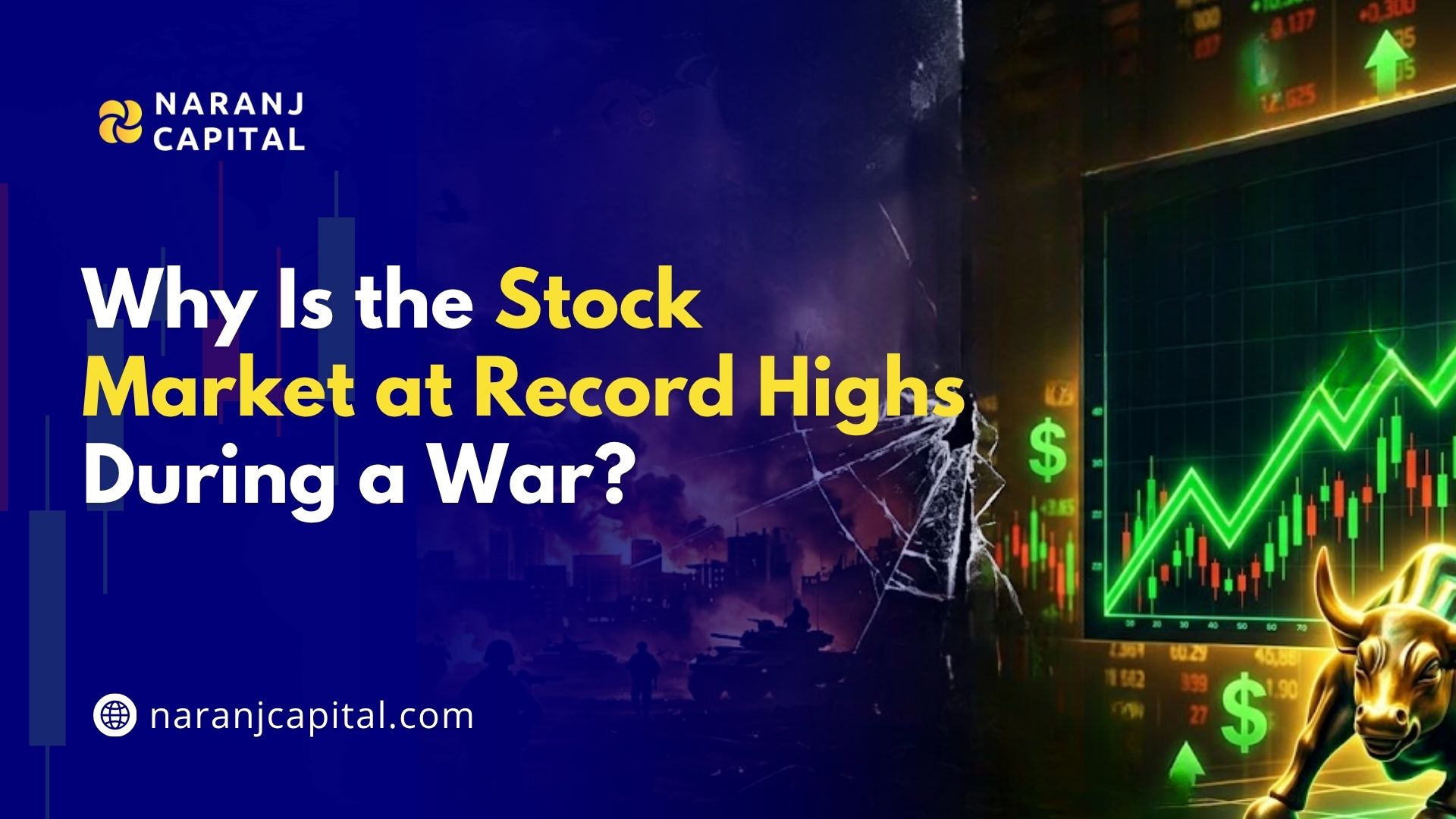
There is a war. Oil is above $100 a barrel. The Strait of Hormuz has been largely closed. Inflation climbed to 3.3% in March 2026.
And yet the S&P 500 just hit a new all-time high.
If that makes no sense to you, you are not alone. Millions of people are asking the same question right now.
Why is the stock market going up when everything looks so bad?
This article answers that question. Simply. Clearly. With real data.
First, what is the stock market actually measuring?
Most people think the stock market measures how the world is doing right now.
It does not.
The S&P 500 is an index of 500 of the largest US companies. When people say the market hit a record high, they mean the combined value of those 500 businesses is at its highest ever point.
But here is the key thing.
The stock market is not a report card on today. It is a bet on what those 500 companies will earn in the future.
Bad news like war, oil price spikes, and rising inflation can shake the market in the short term. And it did. But whether the market stays down depends on one question.
Are companies still going to make money?
Right now, the answer is a very strong yes.
What actually happened when the war started
The war did hit the market. Hard.
When US-Israeli airstrikes on Iran began on February 28, 2026, investors panicked. The S&P 500 fell approximately 8% from February 27 to March 30. Oil prices surged. Airlines, consumer goods companies, and import-dependent businesses fell sharply.
This is completely normal. Bad headlines cause fear. Fear causes selling.
But then something surprised almost everyone.
The market not only recovered. It hit a new all-time high.
On April 27, 2026, the S&P 500 closed at a record 7,174. From its March 30 low, it had gained 13% in just a few weeks. As of late April 2026, the index is up approximately 4% for the year.
So what drove that recovery?
Three reasons the market bounced back
One. Investors priced in the worst and then moved on.
Markets are forward-looking. The initial March drop was investors asking: what if this gets catastrophically bad? Once it became clear that a full economic collapse was not coming, money started flowing back into stocks.
Two. History reassured professional investors.
Fund managers do not just react to headlines. They study data from past conflicts. And history tells a surprisingly consistent story.
Deutsche Bank analysed 30 major geopolitical events since 1939. Across those 30 events, the stock market fell an average of just 4%. And in the first three weeks of a geopolitical shock, stocks typically fall about 6%, then fully recover those losses within the following three weeks.
We saw exactly this in 2026. An 8% drop. Then an 13% recovery to new all-time highs.
Three. Corporate earnings came in far stronger than anyone expected.
This is the biggest reason of all.
The number that explains everything
According to FactSet, one of the most respected financial data firms in the world, this is where things stand as of April 30, 2026.
S&P 500 earnings grew 15.1% year on year in Q1 2026.
That is the sixth consecutive quarter of double-digit earnings growth.
84% of S&P 500 companies that have reported results beat analyst expectations. The five-year average is 78%.
For all of 2026, analysts are projecting 18.6% earnings growth across the index.
Read those numbers again.
While a war is happening. While oil is at $100 a barrel. While inflation is at 3.3%.
American companies are still growing their profits at historically strong rates.
The estimated net profit margin for S&P 500 companies in 2026 is 13.9%. If this holds, it will be the highest annual profit margin recorded since FactSet began tracking this in 2008.
And it is not just big tech companies driving this. While the largest seven technology companies are expected to grow earnings 22.7%, the remaining 493 companies in the S&P 500 are forecast to grow earnings 12.5%. This is a broad, healthy earnings cycle. And earnings are what the stock market ultimately follows.
Why war alone almost never crashes markets long-term
Here is the simplest way to think about it.
The stock market cares about one thing above all others: will these businesses keep making money?
Wars disrupt some sectors. Oil prices rise. Airlines get squeezed. Consumer spending sometimes dips.
But most of the 500 companies in the index continue operating, selling products, and generating profits even during an active conflict.
Consider what Baird Wealth Management's strategists noted in March 2026. The events in the Middle East have come at a time when the US economy is pretty strong. And that makes a huge difference.
Retail sales in the US are at all-time highs. The labour market remains tight. Corporate profit margins are at record levels.
There is also an additional force in 2026. AI capital spending.
According to BlackRock's April 2026 commentary, mega-cap technology companies have increased their spending estimates for 2026 to 2030 by over 25% since October 2025. This spending flows directly into the earnings of semiconductor companies, data centres, energy utilities, and construction firms. It does not stop because of a geopolitical conflict.
Fidelity's own historical research found that there has been little relationship between war and long-term market performance. When Russia invaded Ukraine in February 2022, many predicted a long-term market collapse. That war has now lasted over four years. And yet, since that invasion began, the S&P 500 is up more than 60%.
Should you sell your stocks right now?
The data gives a clear answer.
Selling stocks because of war headlines has historically been a losing move.
Investors who sold during the March 2026 dip and waited for things to calm down missed the entire 13% recovery. By the time things felt safe, the market was already at a record.
Vanguard research shows that investors who move to cash during volatility tend to consistently underperform over the long run. The longer they stay in cash, the worse it gets.
Some of the best single-day gains in stock market history have occurred during periods of maximum fear.
This is the paradox of the market. It is often safest to stay invested when things feel most dangerous. And most risky to sell when headlines are most frightening. This is also why blindly following USA stock trading advice without understanding the underlying data can lead to poor decisions.
That said, risks are real. Oil could spike further. Inflation running above 3% could force interest rates higher. And 53% of S&P 500 companies issuing future guidance have issued negative guidance for Q2 2026. Companies themselves are cautious about what comes next.
The sensible approach is this. Stay invested for the long term. But be aware of which sectors face near-term pressure, like airlines, consumer goods importers, and real estate, and which may benefit, like energy, defence, and commodities.
Conclusion: The market is not saying the war is good news
It is saying something different.
American companies are still making strong profits. And investors believe that will continue.
Those are two very different things.
The market dipped 8% when the Iran war started. It then recovered fully and hit a record high. Corporate earnings are growing at 15.1% in Q1 2026. History shows that markets typically fall just 4% during geopolitical shocks and recover within weeks.
War disrupts some sectors. But most companies keep earning money.
And the stock market, above all else, follows earnings.
Understanding this difference is what separates the long-term investor who stays calm and stays invested from the one who sells at the bottom and buys back at the top. Many investors today combine this understanding with structured support from trading advisory services for US stocks to stay disciplined through volatility.