Introduction
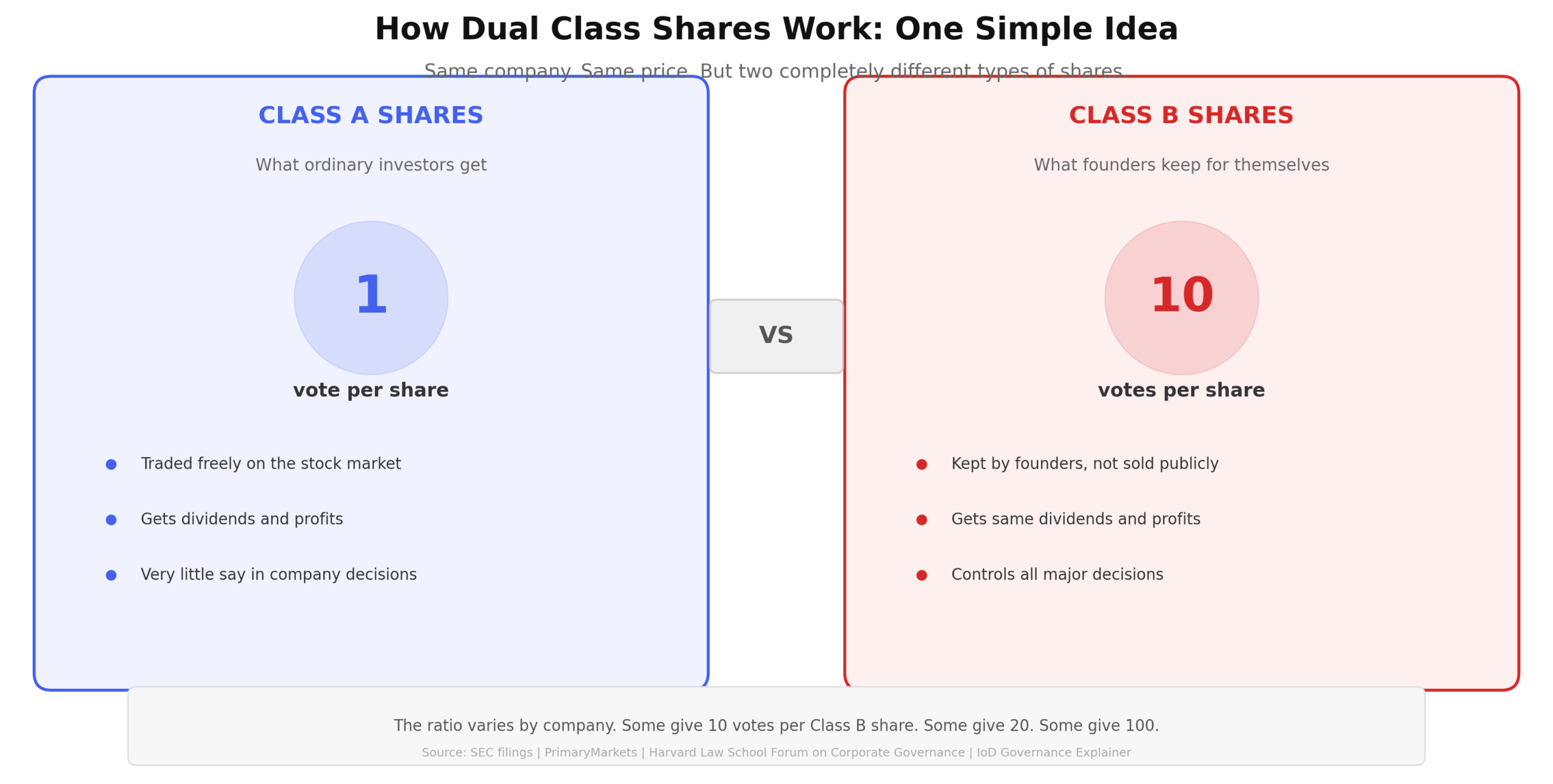
Imagine you and a friend both own shares in the same company. You paid the same price. You both get the same dividends. But when it comes to voting on big company decisions, your friend's one share counts as ten votes. Your one share counts as just one.
That sounds unfair. And in many ways it is. But it is also completely legal. And some of the biggest companies in the world are built this way.
This is called a dual class share structure. And once you understand it, you will see it everywhere.
What does dual class actually mean?
Most companies keep things simple. One share equals one vote. Buy more shares, get more votes. The person with the most shares has the most say. Clean and straightforward.
A dual class structure breaks that rule on purpose.
The company creates two different types of shares. Class A shares go to the general public. They are the ones anyone can buy on the stock market. Each Class A share usually comes with one vote.
Class B shares are kept by the founder or the original owners. These shares are almost never sold publicly. And each Class B share comes with far more votes. Ten votes. Twenty votes. Sometimes even a hundred votes per share.
The result is simple but powerful. The founder can sell most of their economic ownership to raise money. But they keep all the decision-making power locked tightly in their own hands.
Real examples that make this crystal clear
This is not a rare or unusual thing. Some of the most famous companies on earth are structured this way.
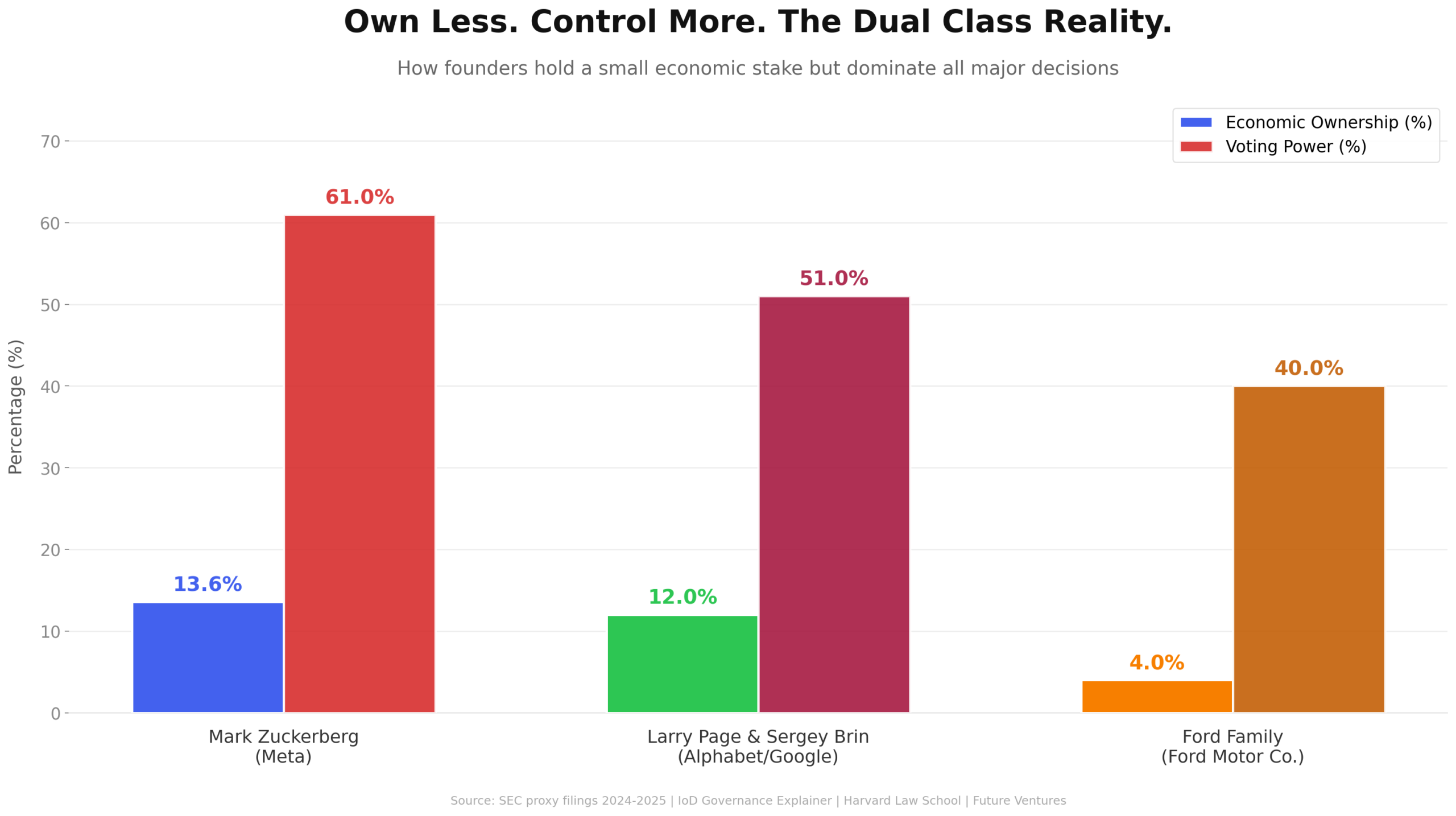
Meta (Facebook) is the clearest example. Mark Zuckerberg owns about 13.6 percent of Meta's total shares. That is not a majority. In a normal company, he would have limited power. But his shares are Class B shares, which carry ten votes each. That gives him 61 percent of all the voting power. He can override every other shareholder combined. Whenever something comes up for a vote at Meta, Zuckerberg wins. Every single time.
Alphabet (Google) goes even further. It has three classes of shares. Class A shares for the public with one vote each. Class B shares held by founders Larry Page and Sergey Brin with ten votes each. And Class C shares, which have zero votes at all. Page and Brin together control about 51 percent of all voting power despite owning a minority of the total shares.
Ford Motor Company is an older and less talked about example. The Ford family owns just 4 percent of the company's total shares. But they control 40 percent of the voting power. A family with 4 percent ownership essentially runs a company worth tens of billions of dollars.
These companies are among the most widely owned stocks in the United States. If you follow a USA stocks advisory, chances are you'll regularly come across businesses with dual class share structures. Knowing how they work helps you understand who really controls the companies behind the recommendations.
Why do founders want this?
Think about what it feels like to build a company from nothing.
You spent years working on an idea. You built it brick by brick. You understand it better than anyone. Then you take it public to raise money. Suddenly thousands of strangers own pieces of your company. And those strangers can vote on your decisions. They can push you to chase short-term profits. They can force you to fire people. They can even vote you out entirely.
Dual class shares solve that problem. The founder raises the money they need from the public but keeps the power to run the company the way they believe is right.
Zuckerberg used this power in a famous way. In 2012, a month before Facebook went public, he decided to buy Instagram for one billion dollars. No revenue. Just a photo app. His board and investors thought he was crazy. The price seemed ridiculous.
But he did not need their approval. His Class B shares gave him the power to just do it.
Instagram today is estimated to be worth over 300 billion dollars. It is the foundation of Meta's business. If Zuckerberg had needed majority shareholder approval, that deal might never have happened.
That is the best possible argument for why dual class shares exist.
The problem nobody should ignore
But here is the other side of the story.
When a founder has complete control and cannot be voted out, there is no real check on their decisions. If they make a brilliant call like buying Instagram, everyone benefits. But if they make a terrible call, there is nothing ordinary investors can do about it.
Zuckerberg spent tens of billions of dollars building the metaverse. A virtual reality world that most users did not want. Meta's stock dropped more than 60 percent at one point because of it. Investors were furious. But they were powerless. No vote could stop him.
The Ford family controls Ford Motor Company with just 4 percent economic ownership. If the family makes poor decisions, the other 96 percent of shareholders bear most of the financial pain. But the family keeps the power regardless.
In 2024, Morningstar studied how dual class structures affected real votes. They found that in 47 shareholder votes at companies with dual class shares, insiders swayed the outcome by an average of 19 percentage points compared to what ordinary investors actually wanted. Nineteen percentage points. That is not a small gap. That is a wall between founders and accountability.
BlackRock and Vanguard, the two largest investors in the world, both voted against Meta's dual class structure in 2024. They were outvoted immediately by Zuckerberg's Class B block. Their billions of dollars of investment gave them no real voice.
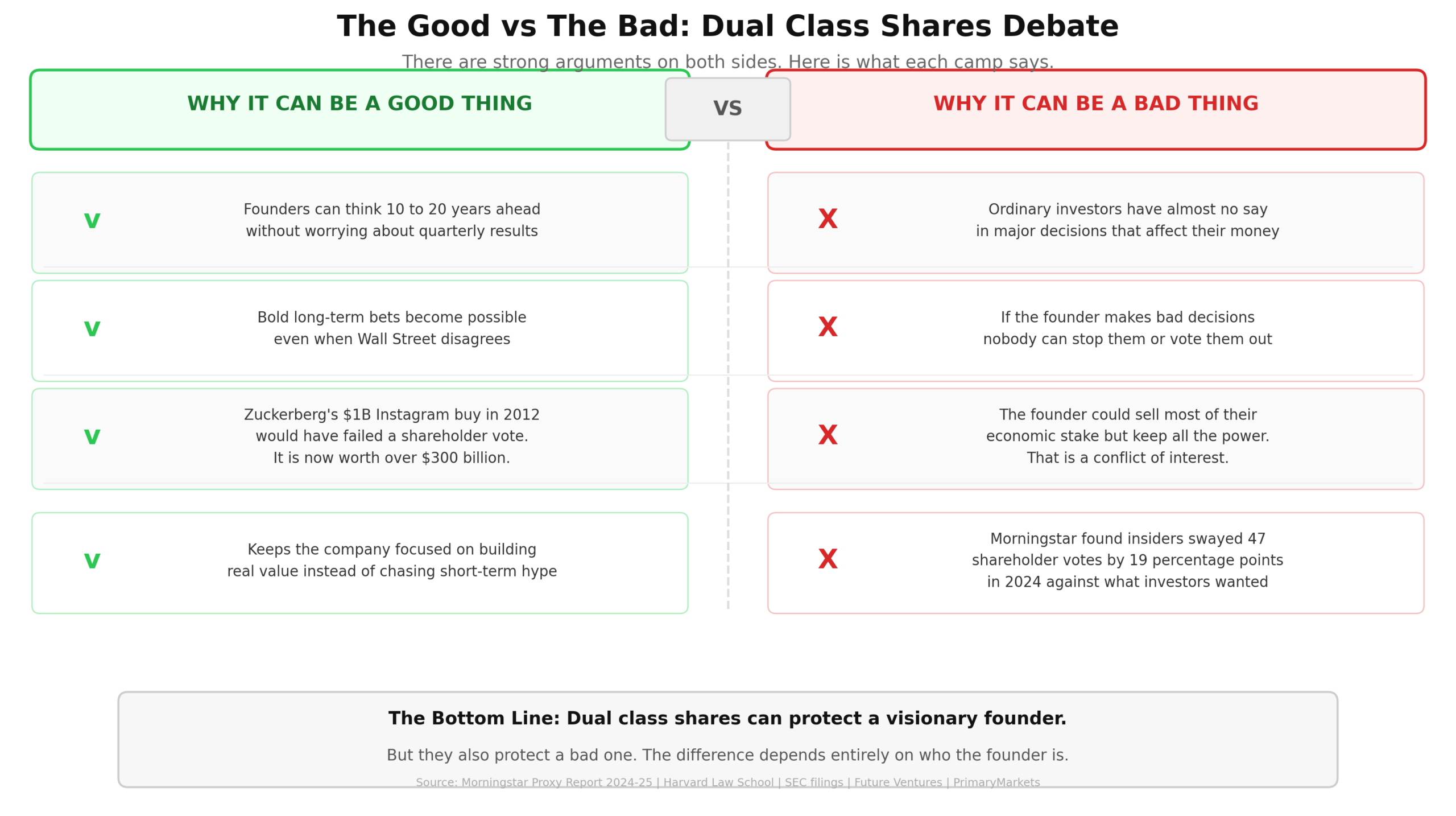
So is this good or bad?
The honest answer is that it depends completely on the founder.
A visionary founder with good judgment and a long-term view is exactly the kind of person you want to have this kind of power. They can make bold decisions without being pulled in every direction by short-term pressure. They can build something extraordinary that a committee would never have approved.
But a founder who is wrong, or who starts prioritising their own interests over their investors, can cause enormous damage. And the ordinary shareholder sitting on the other side of a dual class structure has almost no way to stop it.
The dual class structure protects good founders and bad ones equally. It does not know the difference.
What should you do as an investor?
Before acting on any US stock recommendations, take a minute to check whether the company has a dual class share structure. Most broker platforms and financial news sites clearly mention the share classes and voting rights.
If it does, ask yourself one question. Do you trust this founder enough to give them near-total control over your money with no real way to remove them?
Sometimes the answer is yes. Google and Meta have created extraordinary value for investors despite, or perhaps because of, this structure.
Sometimes the answer should be no.
The share price is never the full story. The voting structure tells you something important about who actually runs the company you are investing in. And that is always worth knowing before you buy.