Introduction
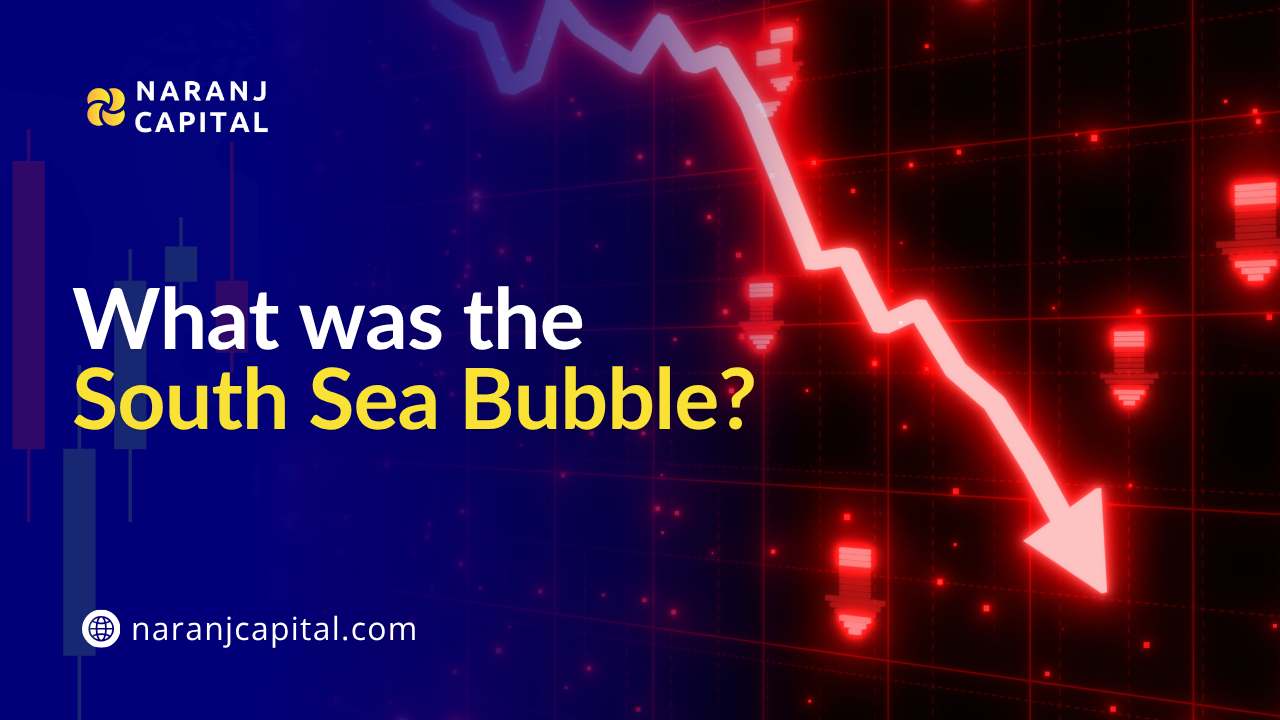
Every time someone on Wall Street says a stock is "in a bubble," they're borrowing a word from a British stock crash that happened three centuries ago, decades before the New York Stock Exchange even existed. This is the South Sea Bubble, and it's still one of the best cautionary tales in market history.
What Was the South Sea Bubble, Really?
The South Sea Company was a British business founded in 1711. In exchange for helping the British government manage its enormous debt from years of war, the company was granted a monopoly on trade with Spanish colonies in South America.
That trade side of the business never really worked out. Spain kept a tight grip on its colonial ports, and the actual profits from shipping goods to South America were modest at best.
In 1720, the company made a bold proposal instead: it would take over most of Britain's national debt, swapping government bonds for South Sea Company shares. Investors, convinced this scheme, and the company's trading prospects, would make them rich, rushed to buy in.
How the Frenzy Built Up
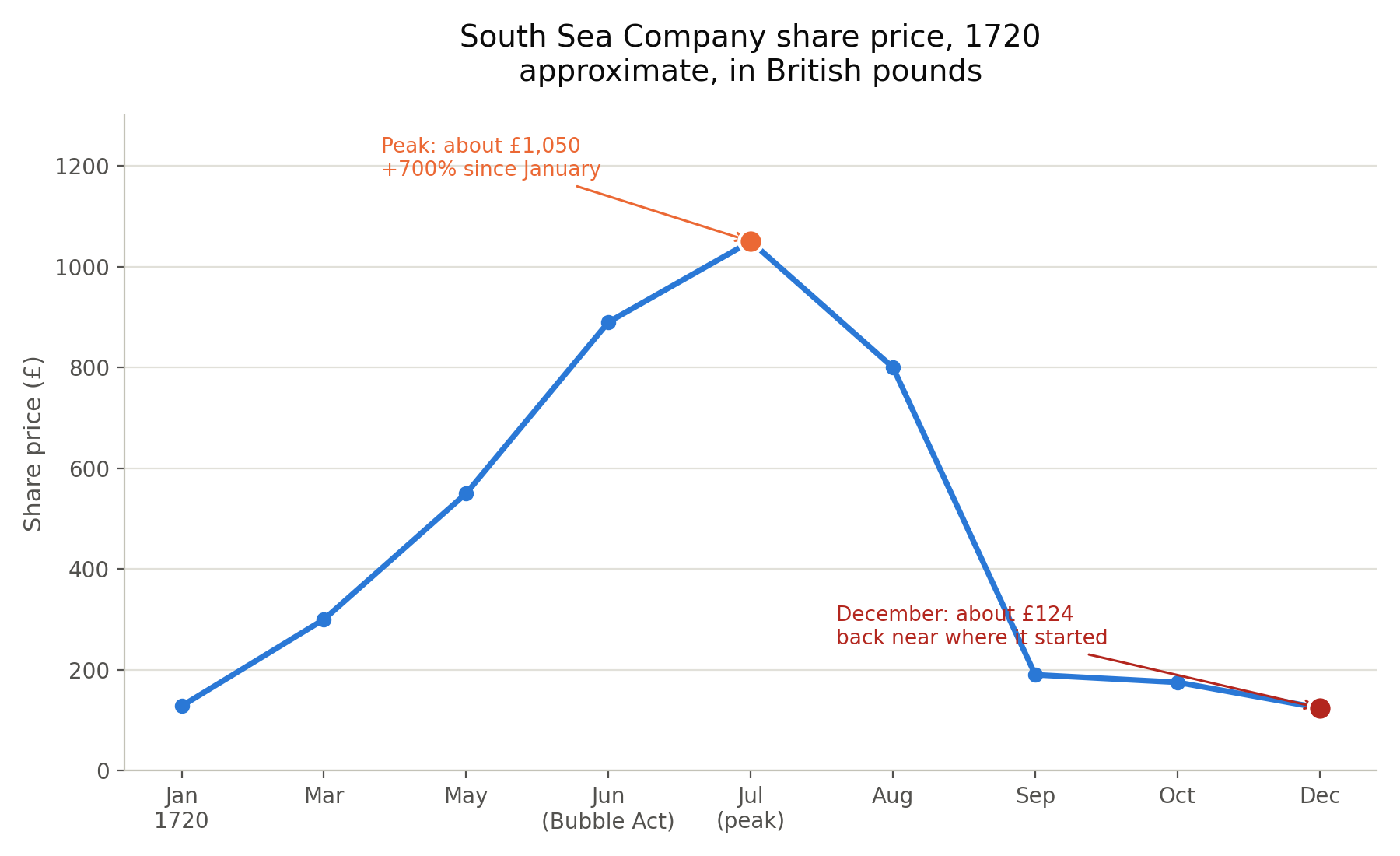
Share price started around £128 in January 1720. As the debt conversion scheme rolled out and hype built around it, the price kept climbing, month after month.
Dozens of copycat companies launched during the same stretch, some with laughably vague purposes, all riding the same wave of speculative enthusiasm. By the summer of 1720, South Sea Company shares had rocketed past £1,000, a jump of roughly 700% in under seven months.
The World's Most Famous Investing Casualty
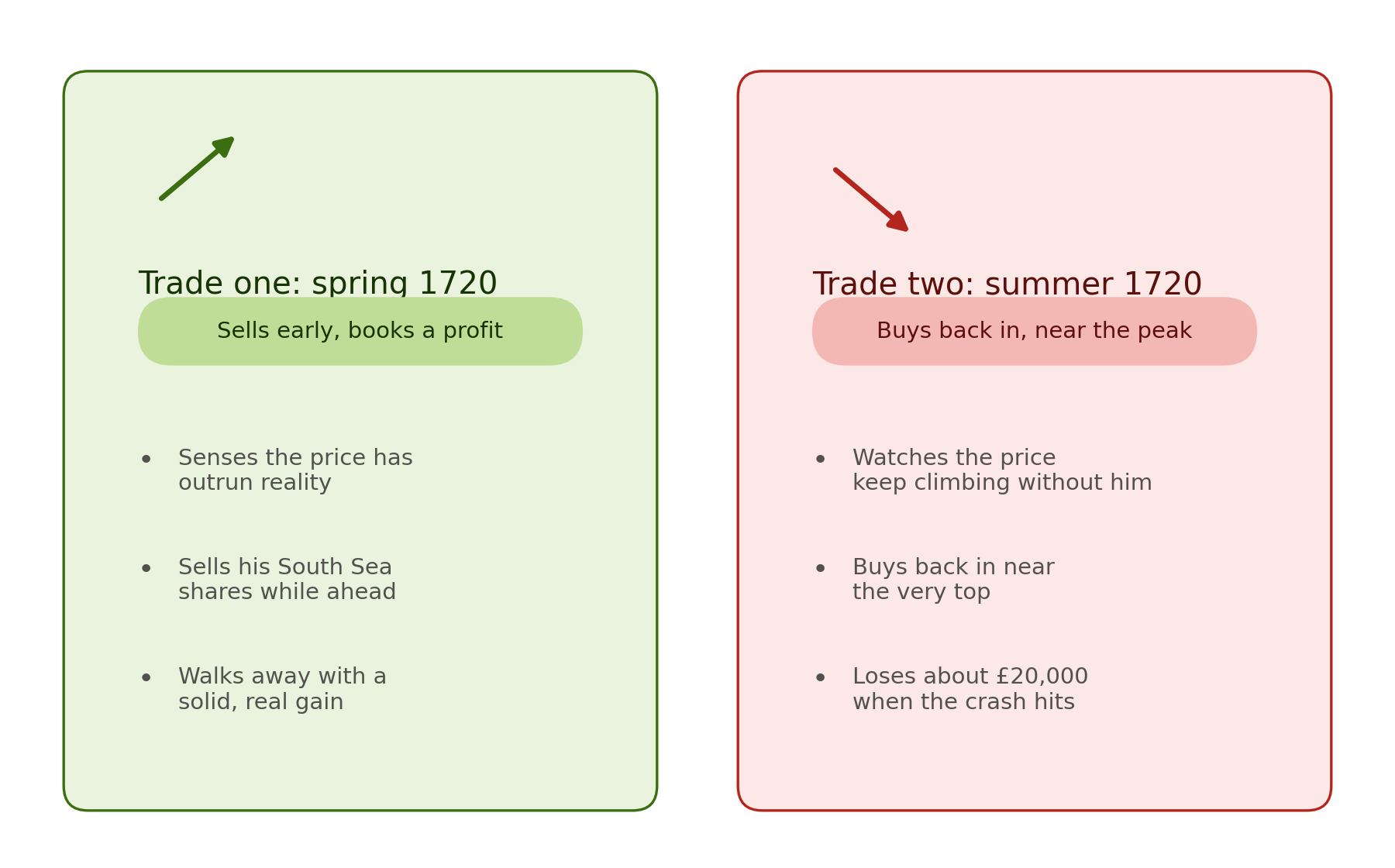
Sir Isaac Newton, one of the greatest scientific minds in history, was an early South Sea Company investor. In the spring of 1720, sensing the mania had gotten ahead of itself, he sold his shares for a solid profit.
Then he watched the price keep climbing. Unable to resist, he bought back in near the very peak. When the crash came, Newton reportedly lost around £20,000, a genuine fortune at the time, worth millions of dollars in today's money.
He's often quoted as saying he "could calculate the motions of the heavenly bodies, but not the madness of people." Historians note the exact wording, and even whether he said it at all, is hard to verify. What isn't in doubt is that one of history's sharpest minds still got swept up by the crowd.
Why It Collapsed
By late August 1720, company insiders, including several directors, began quietly selling their own shares. Word spread. Investors who had borrowed heavily to buy shares on credit suddenly couldn't cover their loans as prices wavered. Confidence evaporated almost as fast as it had built.
By September, the stock had fallen below £200. By December, it settled around £124, close to where it had started the year, wiping out nearly the entire runup in a matter of months.
Why a 300-Year-Old British Crash Still Matters
The South Sea Bubble gave finance its most enduring word. Parliament's Bubble Act, passed the same year to rein in the wave of speculative new companies, helped cement the term into everyday language, and it's stuck around in every stock market since, including Wall Street.
America wouldn't have anything resembling a modern stock exchange for another 70-plus years. But the pattern the South Sea Bubble revealed, hype outrunning fundamentals, easy credit fueling speculation, and a painful reckoning once reality catches up, has repeated itself again and again on American soil, from 1929 to the dot-com crash of 2000.
The same lesson remains relevant when investors evaluate positional trading ideas in USA stocks today. A strong-looking chart or rapidly rising share price can attract attention, but investors still need to consider the company's fundamentals, valuation, market conditions, and the risk of entering after an extended rally.
Lessons for Today's Investors
-
A complicated financial scheme dressed up in official or patriotic-sounding language isn't automatically a safe bet.
-
Selling early because something looks overvalued takes real discipline, and buying back in during a mania can undo all of that discipline in one move.
-
Watching what company insiders are quietly doing, buying or selling, can tell you more than the hype surrounding a stock.
-
Even brilliant, rational people can get swept up in a crowd. Nobody is naturally immune to a mania.
-
Good Trading Advice for USA investors should focus not only on potential returns, but also on valuation, risk, market conditions, and what could invalidate an investment thesis.
Conclusion
Isaac Newton could predict the orbit of planets centuries into the future. He couldn't predict what a crowd of excited investors would do next, and neither can anyone else, no matter how smart.
Three hundred years later, the company is long gone, but the word it left behind is still doing its job: warning anyone willing to listen that a rising price and a rising business are not always the same thing.