- Naranj Research Desk

- 🇸🇦 Saudi Stock Market
- 🇺🇸 USA Stock Market

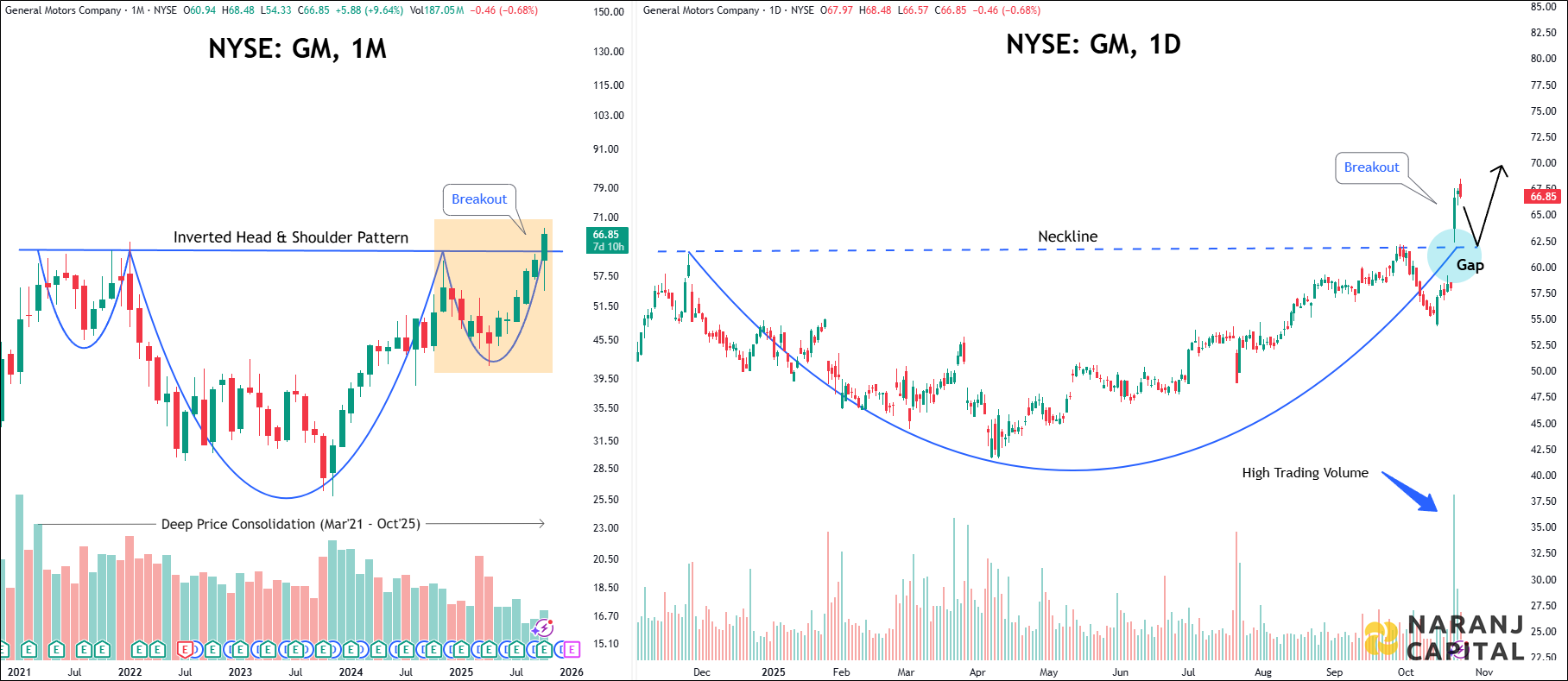
When the global auto industry was rattled by tariffs, regulatory uncertainty, and the volatile EV market, many would have expected General Motors (GM) to struggle. Instead, the Detroit giant did something remarkable: it turned challenges into opportunities — a great example for investors following US trading and investment advice.
In a single day after reporting earnings, GM’s stock jumped 14.7%, its biggest one-day surge in nearly six years. Investors cheered as the company’s market cap climbed near $63 billion, trading at a surprisingly low 6× earnings—a rare combination of value and growth in today’s auto sector.

In Q3 2025, GM posted $48.6 billion in revenue, holding steady despite headwinds. Net income fell 57% YoY to $1.32 billion, driven largely by one-time strategic charges—but the story behind the numbers was far more encouraging.
Adjusted EBIT hit $3.4 billion, which would have been about 9% if not for $1.1 billion in tariff costs—a figure right in GM’s historical “sweet spot” for North America.
Even more striking was the company’s confidence. GM raised its 2025 EBIT guidance by $1.25 billion, from $11.25 billion to $12.5 billion. The message was clear: GM is not just surviving—it’s thriving.
GM’s market share in the U.S. climbed to 17%, the best third-quarter level since 2017. With 710,000 units sold (+8% YoY), the company continues to dominate high-margin segments:

Remarkably, GM’s incentive spending remains low at 4% of the average transaction price, versus the industry’s 6.9%, helping preserve margins even in a fiercely competitive market.
GM isn’t chasing growth blindly. It made a $1.6 billion charge to recalibrate its EV roadmap, focusing on profitability over aggressive volume. The company:
Meanwhile, a $4 billion investment across U.S. facilities increases ICE production and reduces tariff exposure—turning a potential risk into a strategic advantage.
Tariffs could have been a major headache. Instead, GM’s combination of disciplined pricing, manufacturing realignment, and cost control has offset ~35% of gross tariff exposure, lowering net risk and positioning the company for even more relief by 2026.
EVs remain GM’s “North Star,” but now with a sharper focus on profitability. In Q3 2025, GM sold 67,000 EVs, capturing 16.5% of the U.S. EV market. Chevrolet’s Equinox EV became the top-selling non-Tesla EV.
Management is strategically right-sizing production, aiming to reduce EV losses starting 2026 while sustaining innovation.
While the world watched Tesla, GM quietly delivered a fourth consecutive profitable quarter in China, earning $80 million in equity income. Market share rose to 6.8%, with 470,000 units sold (+10% YoY). New energy vehicle sales have grown for ten straight quarters, outperforming many global peers.
GM isn’t just about cars. Its software and services segment, now nearly $2 billion in revenue, is reshaping the company’s future.
This high-margin, recurring revenue stream is becoming a cornerstone of GM’s profitability story.
GM’s commitment to shareholders is clear:
Strong cash flow and shareholder returns reinforce GM’s reputation as a strategically disciplined company.
No story is complete without caution:
Despite all this, GM trades at 6× earnings, a stark contrast to Tesla’s 200× multiple. As Morgan Stanley’s Adam Jonas observed: “GM has higher margins and higher growth than Tesla, and trades at six times earnings—not 200 times.”
GM expects 2026 to outperform 2025, driven by:
With EBIT guidance now at $12–13B, GM is poised for sustainable profitability.
General Motors is no longer just a traditional carmaker—it has become a story of change and resilience. The company has shown it can handle global challenges, adjust its business approach, and make smart, disciplined decisions.
For investors, GM is more than a stock; it shows how a long-standing company can reinvent itself and still deliver steady returns. By balancing innovation, profitability, and careful use of capital, GM proves that strong leadership and clear focus can create lasting value—even in a tough industry.
In short, GM is a prime example of turning challenges into opportunities, making it a strong choice for investors who care about smart strategy, stability, and growth.