Introduction
Saudi Arabia is experiencing a remarkable transformation. Once known primarily for religious pilgrimage, this desert kingdom is now emerging as one of the world's fastest-growing tourism destinations. In 2024 alone, the nation welcomed 29.7 million international visitors—a number that reflects decades of economic change compressed into just a few years. The government aims to attract 150 million visitors annually by 2030, and with current momentum, this ambitious target seems increasingly achievable. This surge is not just about numbers; it represents a complete re imagining of what Saudi Arabia offers to the world.

The Numbers Tell an Incredible Story
The statistics behind Saudi Arabia's tourism boom are genuinely impressive. In 2024, the nation recorded a combined 115.9 million tourists—both domestic and international—and the tourism sector pumped a staggering SAR 283.8 billion (approximately USD 76 billion) into the economy. For international visitors specifically, spending reached SAR 168.5 billion (USD 45 billion). These numbers become even more remarkable when you compare them to pre-pandemic figures. In 2019, before COVID-19 disrupted global travel, Saudi Arabia welcomed 20.29 million international visitors. Fast forward to 2024, and that figure has grown by 47%—nearly 50% more visitors in just five years.
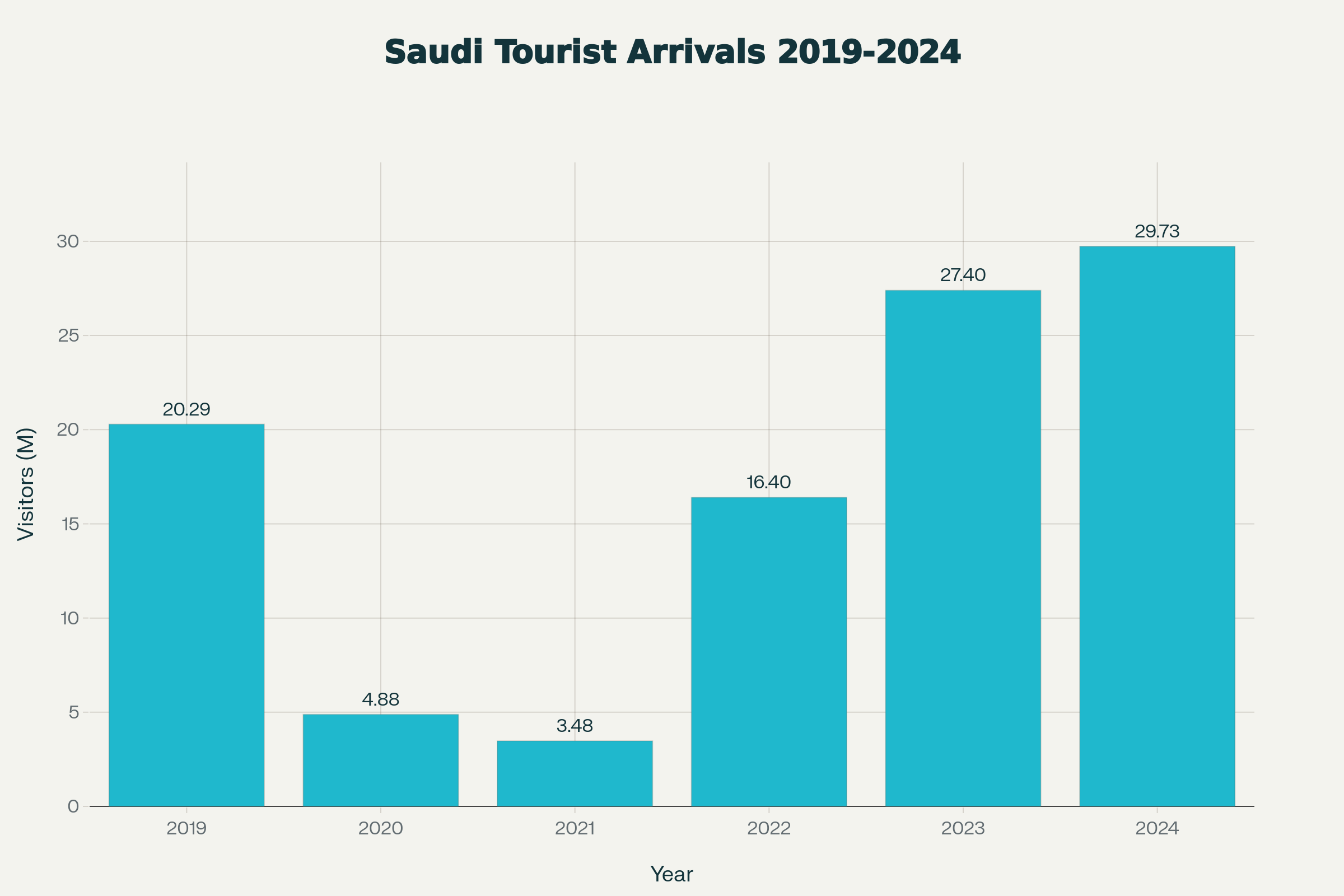
What's particularly striking is how quickly the kingdom recovered and surpassed previous records. The pandemic hit hard in 2020, when arrivals plummeted to just 4.88 million. By 2023, the nation had not only recovered but exceeded pre-pandemic numbers, reaching 27.4 million visitors. The government actually surpassed its original Vision 2030 goal of 100 million annual visitors—achieving this target five years ahead of schedule.
Vision 2030: The Master Plan Behind the Boom
Understanding Saudi Arabia's tourism explosion requires understanding Vision 2030, the government's economic diversification strategy. Launched in 2016, this ambitious plan aimed to reduce the kingdom's dependence on oil revenue by developing new economic sectors. Tourism became a central pillar of this vision, with a target for the sector to contribute 10% of GDP by 2030—up from just 3% in 2019.
The strategy is working brilliantly. In 2024, tourism already contributed 11.5% of the economy, significantly exceeding the original Vision 2030 targets. This is extraordinary progress for a sector that many outsiders didn't even know existed in Saudi Arabia just a decade ago. The government recognized that the kingdom possesses incredible untapped resources: religious significance through Hajj and Umrah pilgrimages, pristine natural environments, ancient archaeological treasures, and enough capital to build world-class infrastructure.
Religious Tourism: The Powerful Foundation
While many envision Saudi Arabia's tourism boom as entirely new, the truth is more nuanced. Religious tourism has always been a cornerstone, and it remains the strongest foundation. In 2024, over 18.5 million pilgrims visited Saudi Arabia for religious purposes—16.9 million for Umrah (the lesser pilgrimage) and 1.61 million for Hajj (the major pilgrimage during specific months). These numbers make Saudi Arabia the host to the world's largest coordinated religious gathering.
What's changing is how the government is optimizing and expanding this experience. The government aims to welcome 30 million Umrah pilgrims annually by 2030, up from 19 million in 2019. In the first quarter of 2025 alone, 6.5 million international visitors performed Umrah—an 11% jump from the previous year. This growth is driven by expanded e-visa programs now covering more than 66 countries, making it easier for Muslims worldwide to plan their pilgrimage.
The infrastructure supporting these pilgrims is equally impressive. The Haramain High-Speed Railway transported nearly 70% of international Umrah pilgrims in 2025, moving them between Jeddah, Makkah, and Madinah in under 45 minutes. The new King Salman International Airport in Riyadh is being designed to handle 120 million passengers annually by 2030. These aren't just incremental improvements—they're transformational projects that elevate the entire pilgrimage experience.
Beyond Religion: Leisure Tourism Takes Off
While religious tourism provides the foundation, leisure tourism is the growth story. This is where the real transformation becomes visible. Since 2019, leisure travel to Saudi Arabia has skyrocketed by an astonishing 656%. This explosion is driven by completely new destinations and experiences that didn't exist before—or weren't accessible to international travelers.
Take AlUla, for example. This northwestern region remained relatively unknown to the global tourism community just a decade ago. Today, it's recognized as Saudi Arabia's first UNESCO World Heritage Site through Hegra, an ancient Nabataean city with stunning rock-cut tombs. AlUla is now a thriving heritage tourism destination combining ancient archaeological wonders with modern cultural events. The region features the stunning Maraya concert hall—a mirrored structure reflecting the desert landscape that hosts world-class performances. Visitors can explore ancient inscriptions, take hot-air balloon rides over desert canyons, or attend cultural festivals like Winter at Tantora.
The Red Sea is another game-changer. This massive regenerative tourism project spans 28,000 square kilometers along Saudi Arabia's northwestern coast and features over 90 unspoiled offshore islands and 200 kilometers of pristine coastline. Operated by Red Sea Global, this development isn't just about luxury—it's about sustainability. The project aims to have 50 hotels with 8,000 rooms spread across 22 islands and 6 inland sites by 2030.
The first resorts already operating are nothing short of spectacular. The St. Regis Red Sea Resort, which opened in January 2024, features 90 overwater and beachfront villas with private pools, designed by renowned architect Kengo Kuma. The Shebara Resort showcases stainless steel overwater villas gleaming across turquoise waters. Meanwhile, Six Senses Southern Dunes offers a desert retreat with intelligent climate control and striking architectural design. By early 2025, five resorts were already welcoming guests, with more opening throughout 2025.
Amaala is another massive development along the Red Sea coast, featuring ultra-luxury resorts focused on wellness and art. When completed in 2027, it will offer over 3,000 hotel rooms across 25 hotels and 943 luxury residential villas. The project combines wellness experiences, cultural offerings, and world-class hospitality in an integrated destination.
Even Riyadh, the capital city, is transforming into a major tourism hub. Riyadh Season, an annual cultural and entertainment festival running from October through March, attracts millions of visitors. The 2024 edition drew over 20 million visitors, and 2025 promises even more with events like tennis championships featuring Novak Djokovic and Carlos Alcaraz, WWE Royal Rumble wrestling events, comedy festivals featuring Kevin Hart and Dave Chappelle, and concerts by international artists. The festival spans six major entertainment zones featuring everything from cultural exhibitions to sporting events.
Diriyah, located just 15 minutes northwest of Riyadh, is another cultural gem. Home to the At-Turaif UNESCO World Heritage Site—a beautifully preserved mud-brick city that was the original home of the Saudi ruling family—Diriyah is becoming a lifestyle and cultural destination. The government is investing significantly in restoration and development to create employment and celebrate Saudi heritage.
Making Travel Easier: Visa Reforms and Digital Innovation
A crucial factor enabling this tourism boom is simplification of travel. Saudi Arabia has fundamentally reformed its visa policies to make entry easier for international visitors. The e-visa program now covers 66 countries, allowing quick online applications. For those seeking to perform Umrah, starting in 2026, pilgrims will be able to perform this religious rite under any visa type—eliminating the need for a special Umrah visa.
The government has also introduced digital innovations making travel smoother. Nusuk, the official Hajj and Umrah "super-app," has been downloaded over 12 million times and is available in 14 languages. This platform handles everything from e-visa processing to itinerary updates, cashless payments, and emergency services. Pilgrims also receive RFID-enabled smart cards storing personal and medical data.
Another innovation is Sarah, the AI tourism assistant pilot program that helps visitors navigate their Saudi Arabia experience digitally. Women can now travel solo more easily, and health protocols have been updated to reflect modern global standards. These changes might seem technical, but they're revolutionary for expanding access to Saudi Arabia.
The Job Creation Phenomenon
One of the most powerful aspects of Saudi Arabia's tourism boom is job creation. The government aims to create 1.6 million tourism-related jobs by 2030. In the first quarter of 2025 alone, tourism employment grew by 4%. These aren't just low-wage positions—opportunities span from front-line hospitality to specialized tour operators, event management, and leadership roles.
The government is particularly focused on Saudization—ensuring Saudi nationals benefit from this growth. By 2028, the kingdom targets 50% localization of tourism jobs in licensed establishments, with milestones of 40% by 2026 and 45% by 2027. Women are emerging as a powerful force, already comprising nearly half the tourism workforce. Wage subsidies have been expanded to cover up to 50% of Saudi workers' salaries in 63 tourism-related occupations.
The Infrastructure and Investment Story
Behind this boom lies staggering infrastructure investment. Saudi Arabia has committed over USD 800 billion to tourism infrastructure development by 2030 under Vision 2030. This includes airport expansions, metro systems, luxury and mid-tier hotels, and transportation networks.
As capital flows into tourism, infrastructure, aviation, and consumer-facing sectors, investors are increasingly tracking listed companies aligned with these national priorities. For those seeking Saudi trading advice for halal stocks, Vision 2030–linked industries offer Shariah-compliant exposure to long-term structural growth themes without deviating from Islamic investment principles.
Major global hotel chains are rapidly expanding, while private accommodation licenses have surged—reflecting diversified tourism demand across price segments.
International Recognition and Global Events
Saudi Arabia's tourism transformation is gaining global recognition. According to UN Tourism data, the kingdom ranked first among G20 nations for growth in international tourist numbers in 2024 and second globally compared to pre-pandemic levels. Time Magazine recognized Riyadh as one of the world's top 20 cities for food experiences, while Madinah and AlUla were named among the world's top tourism destinations.
The kingdom is also set to host major global events that will amplify its tourism profile. Expo 2030 in Riyadh and the FIFA World Cup 2034 across 15 Saudi cities will bring international attention on an unprecedented scale. The World Cup alone is driving planning for over 230,000 hotel rooms and will require massive workforce deployment across hospitality, transportation, and event management.
The Path Forward: Ambitious Yet Achievable
Looking ahead to 2025 and beyond, the momentum is undeniable. International tourist arrivals are projected to exceed 120 million by the end of 2025, with potential to reach 127 million. In the first half of 2025, the kingdom welcomed 60.9 million visitors—both domestic and international—with spending reaching SAR 161.4 billion. Tourism is now projected to contribute more than 10% of Saudi Arabia's GDP in 2025, with sector employment reaching an all-time high of 2.7 million workers.
The target of 150 million annual visitors by 2030 might have seemed impossible a few years ago. Today, it seems not just achievable but likely. The combination of world-class infrastructure, carefully planned destinations, cultural preservation, sustainability focus, and genuine hospitality is creating something special.
Conclusion: A Desert Kingdom Transformed
Saudi Arabia’s tourism boom represents one of the most dramatic economic transformations of the modern era. In less than a decade, a nation once defined by oil exports and pilgrimage has become a diversified global tourism powerhouse.
Beyond tourism itself, this transformation is reshaping Saudi Arabia’s investment landscape. As capital flows align with policy execution and sector leadership evolves, informed KSA trading and investment advice becomes essential for navigating opportunities, valuations, and market cycles in a rapidly changing economy.
This isn't just a tourism boom. It's a complete transformation of what's possible when vision, investment, and determination align. Saudi Arabia is no longer an emerging tourism destination—it's become a global powerhouse, and the best is yet to come.