Introduction
Have you ever wondered what happens after you invest money in a mutual fund or an index fund?
Most people think their money simply grows over time. But in reality, that money is used to buy shares of real companies. And the company managing your investment gets to vote on important decisions at those businesses.
That might sound normal. But here is something surprising.
Just three companies have become the biggest owners of many of the world's largest businesses. They own large stakes in airlines, banks, technology companies, retailers, healthcare companies, and many other industries.
Those three companies are BlackRock, Vanguard, and State Street.
Together, these three companies have more influence over Corporate America than almost anyone else.
Understanding how institutional ownership works is valuable whether you are a long-term investor or someone looking for US stock market recommendations based on market trends, sector strength, and company fundamentals.
What Do These Companies Actually Do?
BlackRock, Vanguard, and State Street are asset managers.
Millions of people trust them with their retirement savings, pension money, and investment accounts. The firms invest that money on behalf of their clients.
A large part of these investments goes into index funds.
An index fund is very simple. Instead of trying to guess which stocks will perform best, it buys every company in a market index.
For example, an S&P 500 index fund buys shares in all 500 companies in the S&P 500.
Because there is very little research involved, these funds charge low fees. Over long periods, they have also outperformed many actively managed funds, making them popular with investors around the world.
As more people invested in index funds, the companies running those funds became incredibly large.
How Much Money Do They Manage?
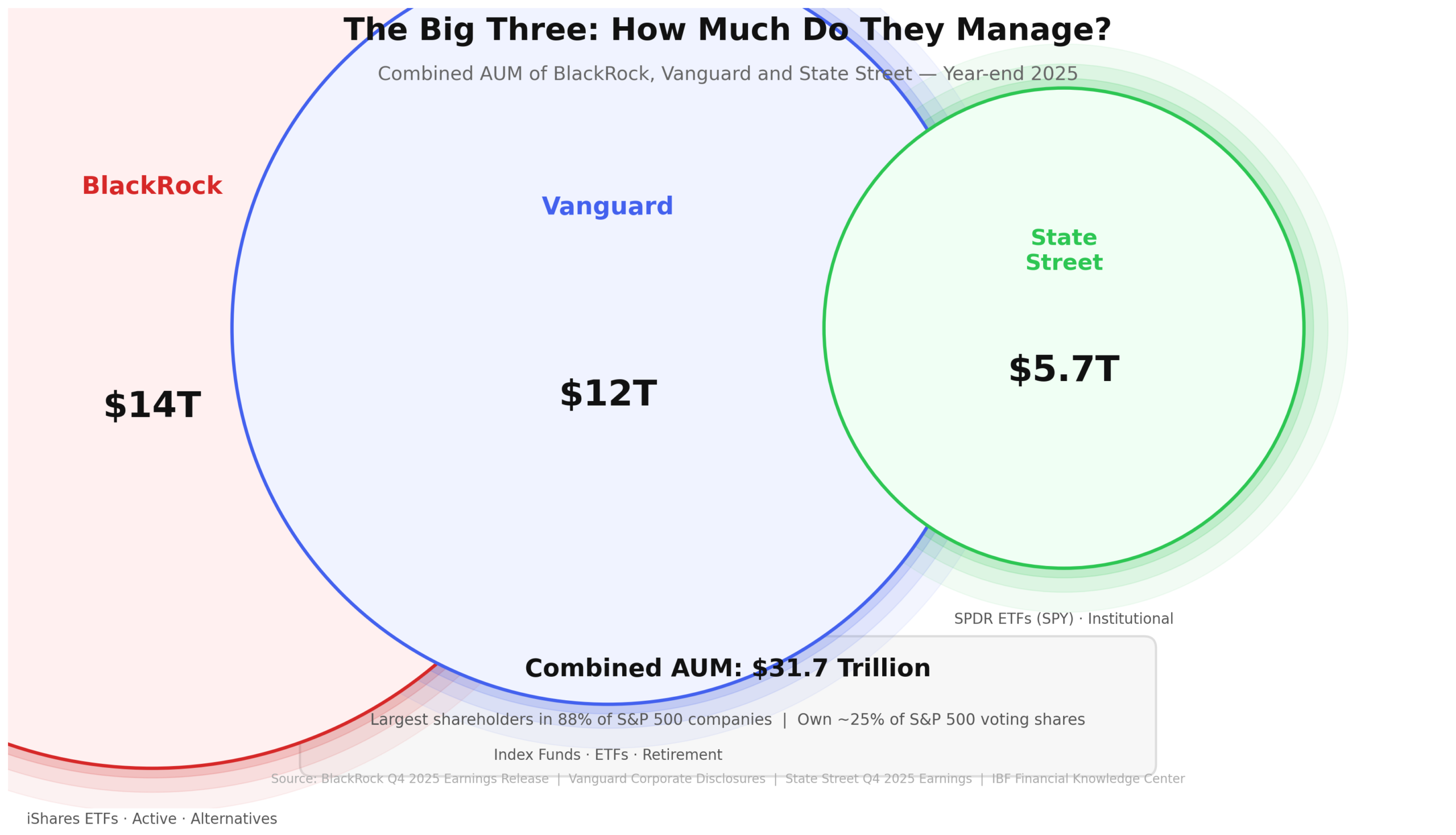
By the end of 2025:
- BlackRock managed about $14 trillion
- Vanguard managed about $12 trillion
- State Street managed about $5.7 trillion
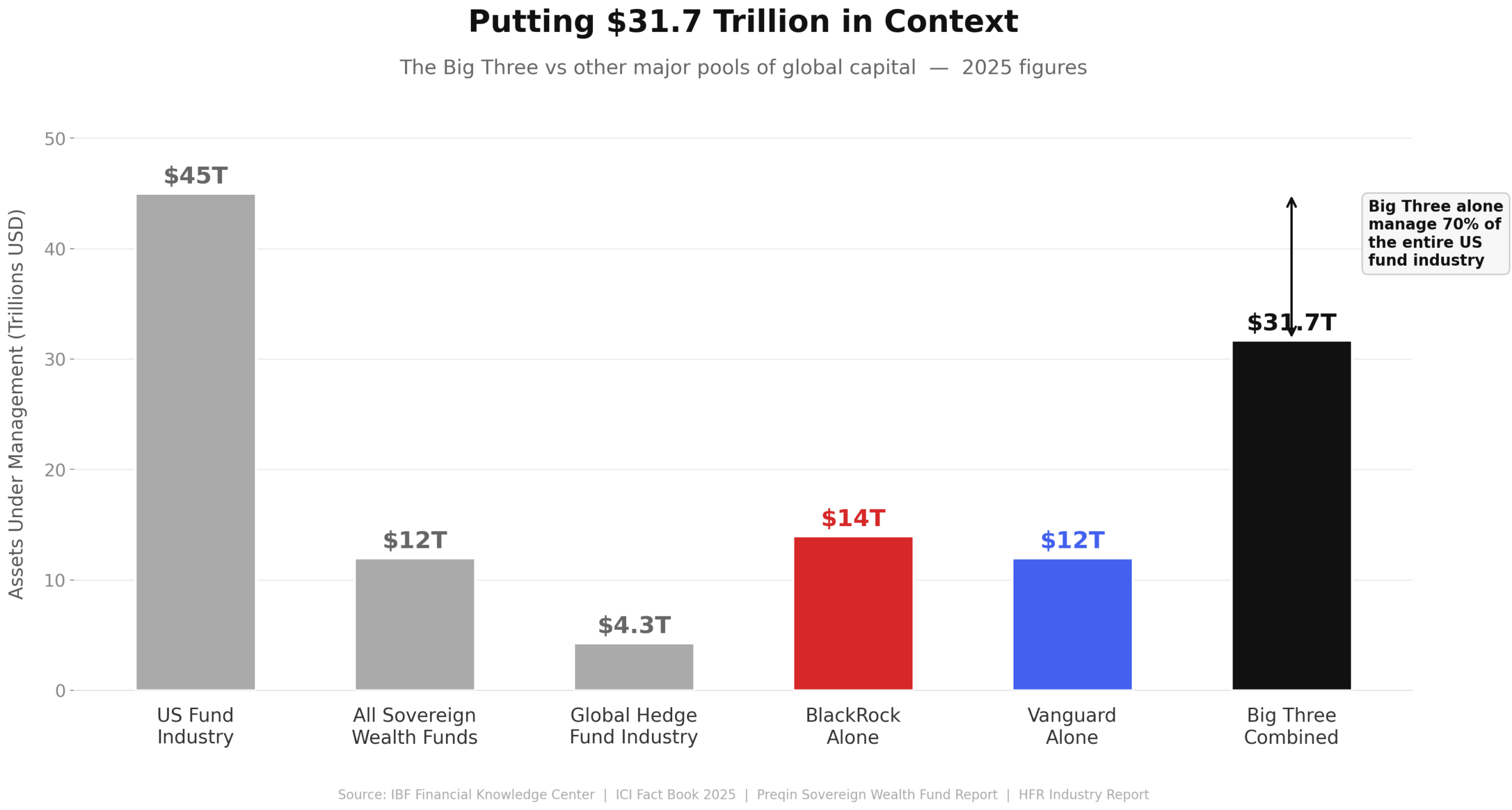
Together, they managed more than $31 trillion.
That is an enormous amount of money.
For comparison, sovereign wealth funds owned by governments around the world manage roughly $12 trillion combined. The Big Three manage far more than that.
Why Do They Own So Many Companies?
The answer is simple.
Index funds buy every company in an index.
If millions of investors continue buying the same index funds every month, the fund managers keep buying more shares of every company in that index.
After many years, BlackRock, Vanguard, and State Street became major shareholders in almost every large American company.
Today, they are the largest shareholders in about 88% of S&P 500 companies.
Together, they control roughly 25% of the voting shares across the index.
That means about one out of every four votes at shareholder meetings comes from one of these three firms.
How Did This Happen?
The story began in 1976.
John Bogle founded Vanguard with a simple idea.
Instead of paying expensive fund managers to try to beat the market, investors could simply buy the entire market through a low-cost index fund.
Many people thought the idea would fail.
Instead, it transformed investing.
Over the following decades, investors moved trillions of dollars into index funds.
BlackRock built the world's largest ETF business through iShares.
State Street launched the first U.S. exchange-traded fund (ETF), SPDR S&P 500 ETF (SPY), in 1993.
By 2019, Americans had invested more money in passive index funds than in actively managed funds for the first time.
As index investing became more popular, ownership of large companies became increasingly concentrated in the hands of these three firms.
Why Are Some People Concerned?
This is where the debate begins.
Imagine one person owns several competing airlines.
Would that owner really want one airline to destroy the others?
Probably not.
The owner benefits if all of them remain profitable.
This idea is known as common ownership.
BlackRock, Vanguard, and State Street own shares in competing companies across many industries.
For example, they own large stakes in:
- Major U.S. airlines
- Large banks
- Apple and Microsoft
- Pepsi and Coca-Cola
- Walgreens and CVS
Some economists argue that when the same investors own competing businesses, companies may have less incentive to compete aggressively.
A 2018 academic study suggested airline ticket prices were higher in markets where common ownership was greater.
One legal scholar even argued that this kind of ownership could raise antitrust concerns.
Some experts described it as one of the biggest competition debates that most people had never heard about.
But Not Everyone Agrees
There is another side to the story.
Index fund managers do not choose which companies to own.
Their job is simply to follow an index.
They also have a legal duty to act in the best interests of their investors.
Research on common ownership is also mixed.
Some later studies found little evidence that common ownership reduces competition, while others reached different conclusions.
So far, regulators have not taken major action against index fund ownership.
The debate continues.
The Influence Everyone Accepts
Regardless of the competition debate, one fact is clear.
BlackRock, Vanguard, and State Street vote on important decisions at thousands of companies.
Their votes can influence board elections, executive pay, mergers, and corporate policies.
During the early 2020s, BlackRock CEO Larry Fink encouraged companies to pay more attention to climate-related risks.
Because BlackRock is one of the largest shareholders in many companies, its views received significant attention.
Later, political pressure led several large asset managers to reduce some of their public ESG initiatives.
Whether people agreed with those policies or not, the episode showed how much influence these firms have over corporate decision-making.
What Does This Mean for Investors?
The rise of the Big Three was not the result of a secret plan.
It happened because millions of ordinary people chose low-cost index funds for their retirement and long-term savings.
For most investors, index funds are still one of the best ways to build wealth over time.
At the same time, market participants with shorter investment horizons often rely on short term trading signals for US stocks to identify momentum-driven opportunities instead of simply tracking broad market indices.
But their success has created something new.
Three investment firms now hold significant ownership in many of the world's largest companies and cast millions of shareholder votes every year.
Most investors never notice this because the firms are investing on their behalf.
Understanding how this system works does not mean you should avoid index funds.
It simply means recognizing that a small number of asset managers now play an important role in shaping many of the companies that influence our everyday lives.
That is a remarkable amount of influence—and one that will likely continue growing as more money flows into index funds.